

Explainer Series 4: Examining the “Foreign Agent” Narrative in Uganda

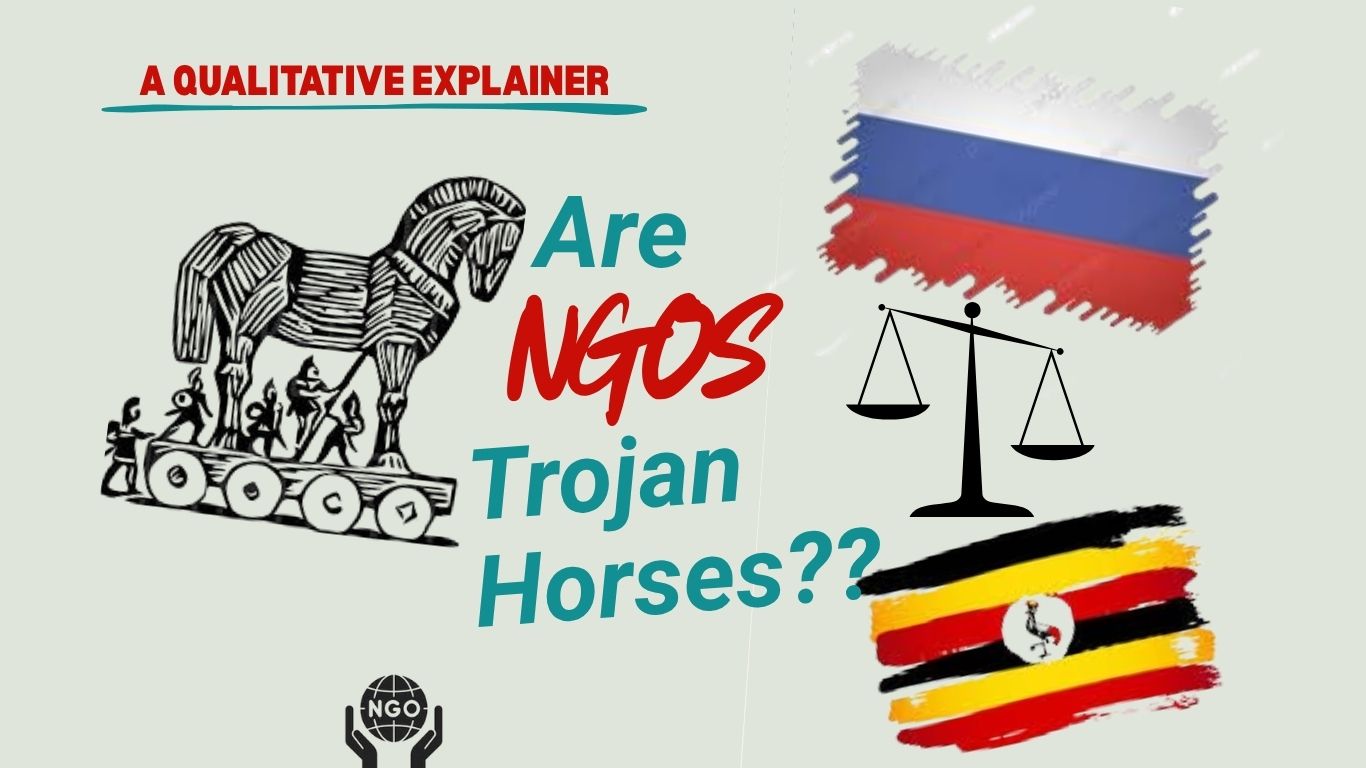
NGOs Aren’t Trojan Horses. They’re Building Blocks of Uganda’s Development
In recent years, the Ugandan government has increasingly cast suspicion on Non-Governmental Organisations (NGOs), echoing a tactic once used in Russia, where Civil Society Organisations (CSOs) were branded as “Trojan horses” for foreign powers. You can check this here, here, and here.
The label suggests that NGOs, especially those with foreign funding, are secretly undermining sovereignty and serving outside interests. But the reality is a different story here in Uganda. Many NGOs have been essential partners in the social and economic development, delivering services that reach millions of people across the country, and not necessarily infiltrators who seek to undermine the “independence” of the country.
The Rhetoric of Trojan Horses
Whether the NGOs The “Trojan horse” hides inside a wooden horse (service and developmental aid) to capture Troy (Uganda’s sovereignty); it’s a borrowed framing, often around election seasons or moments of political tension; for instance, during the 2021 elections, several organisations monitoring human rights and civic participation were accused of advancing foreign agendas.
Authorities suspended 54 NGOs here, here, here, here, claiming they were non-compliant with regulations in 2021; however, the affected organisations argued the actions were a politically motivated crackdown on civil society and NGOs.
“Authorities in Uganda have suspended more than 50 civic groups for allegedly not complying with regulations, dealing a blow to hundreds of thousands of people who directly benefit from the organisations’ activities,” reads a publication by Al Jazeera.
Most of the suspended groups were active in governance and election monitoring work that directly checks government power, like Chapter Four Uganda and the NGO Forum, the Citizens’ Coalition for Electoral Democracy in Uganda (CCEDU), among others.
The then Executive Director of Chapter Four, Nicholas Opiyo, said that he was surprised by the actions of the NGO Bureau, arguing that his organisation had always filed its annual returns and was working with the authorities to clarify what he believed was a misunderstanding.
“We’ll be writing to the National Bureau for NGOs, reminding them of documents filed with them and other authorities in January this year. We have always acted above board and repudiate any representation of unlawful conduct on our part,” Opiyo said in 2021.
Diana Nabiruma, the senior communications officer at Africa Institute for Energy Governance (AFIEGO), another organisation that was affected, told Uganda Radio Network (URN) in an interview republished by the Independent Magazine that their organisation is registered with the Uganda Registration Services Bureau (URSB) as a non-profit making company.
In the interview, she noted that there have been several attempts by the government to discredit them and that the Financial Intelligence Authority (FIA), an agency that was started to monitor, investigate, and prevent money laundering, has often attempted to investigate their bank accounts on trumped-up allegations.
Russia’s hostility toward NGOs was rooted in deep suspicion of Western influence in the runnings of their general affairs, but in Uganda, the narrative often acts on and as political cover by allowing authorities to justify restrictions or clampdowns without presenting evidence of wrongdoing.
Opiyo argued that the accusations were designed to criminalise legitimate advocacy.
He told Human Rights Watch in an interview in 2021: “The suspension had created an atmosphere of fear and uncertainty in the sector and prevented the organisation from doing its work, which includes public interest litigation. “Numerous cases [we were working on] have either stalled or have been dismissed by courts,” Opiyo said.
What NGOs Actually Do in Uganda
Far from undermining Uganda, NGOs help build it. They provide services in areas where the state has limited capacity, for example, in healthcare, education, governance, women’s empowerment, and human rights, among others.
Health
Suspended organisations like the Foundation for Women Empowerment for Sickle Cell Aid have played a vital role in empowering women who are carers or have sickle cell disease in Uganda. Through other partners, they create programmes that sensitise, as seen here, here, here, and here to empower and provide access through other similar organisations like Uganda Sickle Cell Rescue Foundation (USCRF), Friends of Sicklers Uganda Foundation (FSF-U), and Sickle Cell Association of Uganda (SAU), among others.
Education
NGOs such as Wanyange Child Support Foundation, Support Girl Child Uganda, Islamic Da-awah and Orphanage Foundation, and St Francis Foundation for the Poor provide support to children, girls, and orphans by providing educational needs and mentorship programmes to keep them in school and help them pursue opportunities.
Although education was made accessible in Uganda when Universal Primary Education (UPE) and Universal Secondary Education (USE) were introduced, other costs like providing scholastic materials have not been addressed, which causes some learners to drop out of school.
In 2023, Martin Okaya, the technical advisor for education at Plan International, told Daily Monitor: “Whereas the government sends capitation grants to UPE schools, the hidden cost of education, like buying scholastic materials and uniforms, has not been addressed.”
“Government should find a way of addressing the hidden costs. Years ago, the government used to provide pencils, books and uniforms for UPE pupils,” Okoya added.
Today NGOs with an interest in the education sector, like Support a Girl Child Uganda, Joy for Children, Plan International, BRAC, Save the Children, and World Vision, have come in to ensure increased value of the opportunity (access education freely) by improving learners’ readiness, learning, safety and retention here, here and here.
Governance
Groups like Chapter Four Uganda and the Uganda National NGO Forum monitor elections, provide civic education, and document human rights violations. During the 2021 elections, Chapter Four trained observers to report irregularities, while Rise Up Uganda amplified civic voices in marginalised communities.
These are not examples of foreign infiltration; they are concrete contributions to Uganda’s growth and resilience.
During the 2024 Human Rights Convention, Opiyo said Uganda has had violent elections since National Resistance Army (NRA) rebels took power but that elections should not be like that.
“We can have a discussion on how to ensure we have peaceful elections, proper public discussions, the transparency of the law and electoral processes,” he said in the Monitor
He said space for such engagements is getting narrower with the closure of several NGOs that offered platforms for such discussions.
“We need to change the paradigm that views civil society as a security concern. We are development partners. We are nobody’s agent. We are Ugandans exercising our franchise. The fact that we get money from outside does not make us foreign agents. If that was the case government would be the biggest foreign agent.” he added
The Risks of Mischaracterisation
Labelling NGOs as “Trojan horses” carries real dangers.
When Chapter Four Uganda was suspended in 2021, activists expressed fears that election monitoring and human rights reporting would collapse, leaving abuses unchecked.
Suspicion also discourages international donors, leading to funding cuts that directly affect communities. In 2021 Democratic Governance Facility (DGF), a major donor to most NGOs and some government agencies at the time in Uganda, was investigated, which later led to its exit, affecting the beneficiaries.
Communities, especially in rural and underserved areas, feel the impact first. If NGO programmes close or if literacy programmes pause due to funding gaps or suspension, ordinary Ugandans bear the burden. For instance, in 2019, the Legal Aid Service Providers Network (LASPNET), a beneficiary of DGF, opened a legal aid call centre here at its offices in Mengo to enable citizens in different parts of the country to receive legal aid services. Following the exit of DGF from Uganda, the legal aid in Uganda suffers as ordinary citizens struggle to access justice.
Why It Matters to Set the Record Straight
Recognising NGOs as legitimate partners as a country strengthens trust with both local communities and international donors.
Civil society groups always emphasise that their legitimacy comes from serving Ugandans, not from foreign sponsors.
Their work reflects local struggles and aspirations, from grassroots health campaigns to civic education drives.
Conclusion
NGOs in Uganda are not necessarily Trojan horses; they are building blocks of development, providing healthcare, expanding education, defending rights and justice and strengthening governance.
Recognising their contributions is essential to resisting misinformation, protecting civic space, and ensuring Uganda’s progress continues.
Far from undermining sovereignty, NGOs help create a stronger, more inclusive, and resilient nation.