

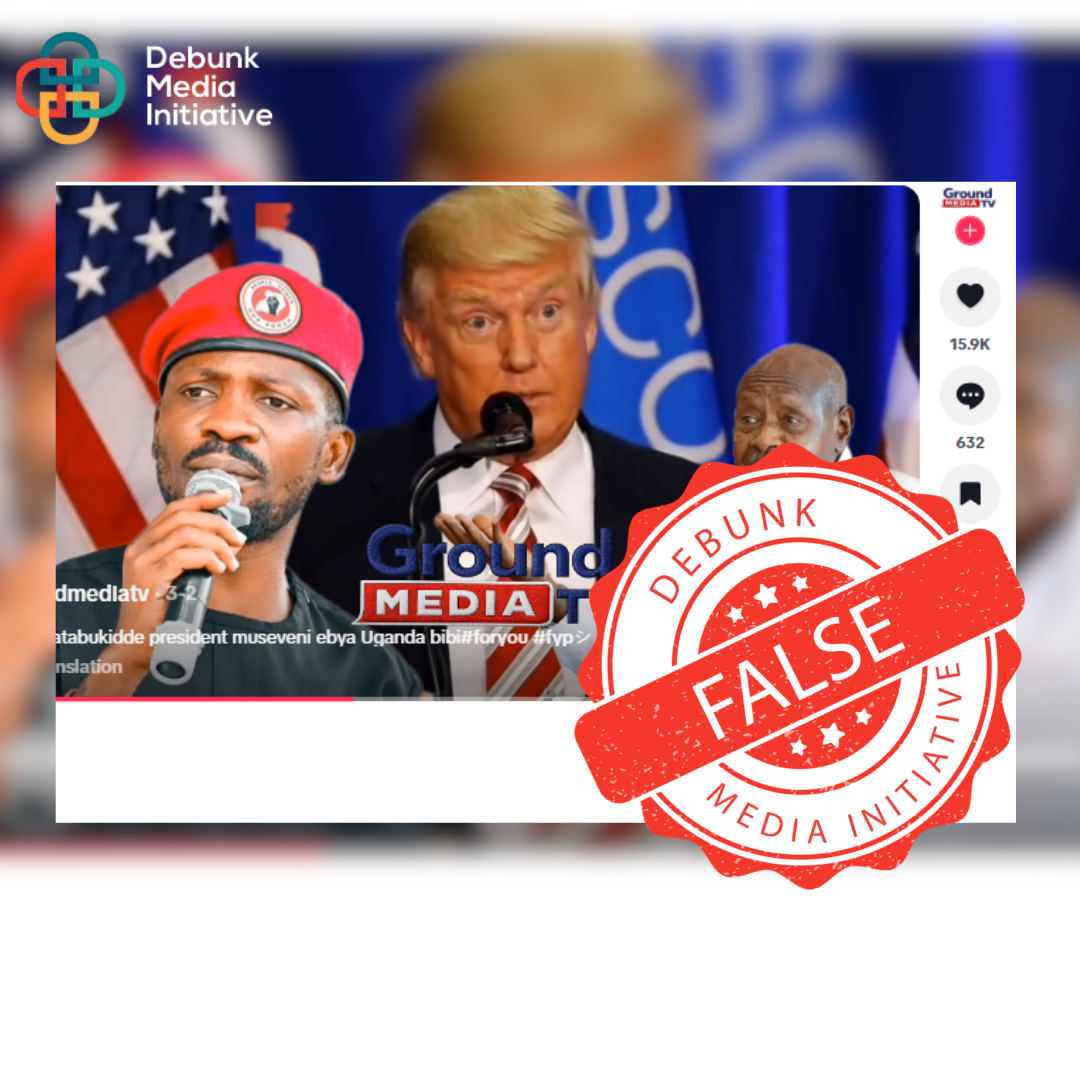
FALSE: AI-Generated Video Falsely Claims Donald Trump Criticised Museveni Over Bobi Wine

Background:
Uganda’s political environment has frequently attracted international attention, especially during election cycles involving opposition leader Bobi Wine and long-serving president Yoweri Museveni.
Because of this global attention, social media posts that appear to show foreign leaders commenting on Uganda’s politics can quickly spread and influence public opinion.
Recently, a TikTok video began circulating claiming that former U.S. president Donald Trump delivered a speech condemning Museveni’s leadership and calling attention to alleged violence against Bobi Wine and his supporters.
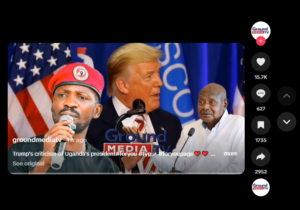
The video shows Trump speaking at a podium while a voice resembling his claims Uganda’s elections are “a joke” and urges an end to violence against Bobi Wine.
Given the potential diplomatic implications of such remarks, the claim required careful verification.
Claim:
A viral TikTok video claims that Donald Trump publicly criticised President Museveni and condemned the treatment of Bobi Wine during a speech, warning that “America is watching.”
Engagement Indicators:
By the time the claim was flagged for verification, the TikTok post had accumulated 15.7K likes, 627 comments, and 2952 shares.
Several comments expressed distress and appeals for international intervention, including statements such as:
- “Please rescue Uganda, there is a lot of torture”
“Help us Mr President Donald Trump, Uganda is bleeding.”
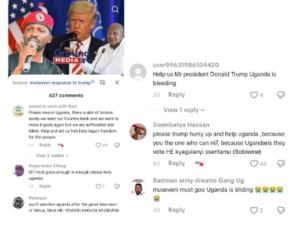
The emotional reactions suggest the content may have influenced viewers’ perceptions of international involvement in Uganda’s politics.
Findings:
Our investigation shows that the claim is false and misleading. The speech circulating online is not authentic, and it is an AI-generated audio placed over an unrelated video of Donald Trump.
1. InfoVerifier Tool Found No Verified Statement by Trump About Uganda
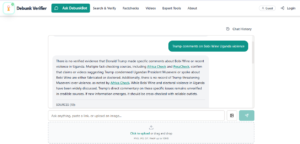
The InfoVerifier returned the following result:
“There is no verified evidence that Donald Trump made specific comments about Bobi Wine or recent violence in Uganda. Multiple fact-checking sources, including Africa Check and PesaCheck, confirm that claims or videos suggesting Trump condemned Ugandan President Museveni or spoke about Bobi Wine are either fabricated or doctored. Additionally, there is no record of Trump threatening Museveni over violence.”
The tool further noted that Trump’s direct commentary on Bobi Wine or Ugandan political violence remains unverified in credible sources.
2. Reverse Search Shows the Video Is From an Unrelated 2016 Speech
A reverse search of the video revealed that the footage used in the viral clip originates from a 2016 campaign speech delivered by Donald Trump in Phoenix, Arizona.
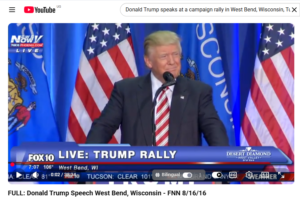
The original speech focused on U.S. immigration policy and border security.
A full transcript of the speech published by Politico confirms that Uganda is never mentioned, Bobi Wine is never referenced, president Museveni is never discussed.
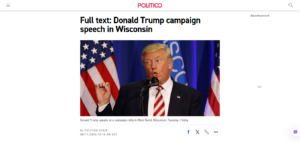
This shows that the viral video reuses legitimate footage but replaces the original audio with fabricated narration.
3. AI Voice Indicators Suggest the Speech Was Artificially Generated
A review of the audio characteristics in the TikTok clip revealed several signs consistent with AI voice cloning, including:
- Speech pacing that does not match Trump’s typical speaking rhythm
- Unnatural transitions between phrases
- Words such as “Uganda” and “Bobi Wine” sound inserted rather than naturally spoken
- Lip movements in the footage do not align with the spoken words
These indicators strongly suggest the speech audio was synthetically generated and overlaid onto the original video.
4. Language and Framing Do Not Match How U.S. Presidents Address Foreign Issues
A closer analysis of the wording used in the viral speech reveals several phrases that are inconsistent with how U.S. presidents typically speak about political situations in other countries.
One of the opening lines in the clip states, “We have a very sad situation in Uganda.”
This phrasing suggests ownership of the situation, as if the speaker is part of Uganda’s internal political system. However, U.S. presidents rarely describe another country’s internal political issues using “we have” because that language implies domestic responsibility.
When addressing foreign political situations, U.S. leaders generally use diplomatic framing, such as:
- “There are concerns about the situation in…”
- “We are monitoring developments in…”
- “The United States is concerned about reports from…”
Using “we have a very sad situation in Uganda” would therefore be unusual diplomatic language for a U.S. president discussing another sovereign nation.
Another linguistic indicator that the speech is not authentic appears in the line “They wanna make Uganda great again.”
This phrase appears to imitate the well-known political slogan “Make America Great Again”, which was used extensively by Donald Trump during the 2016 U.S. presidential campaign.
However, Trump’s slogan was specifically framed around American domestic politics and national identity, emphasising economic revival, immigration policy, and U.S. global competitiveness.
Adapting the slogan to say “Make Uganda Great Again” would be highly unusual for several reasons:
- The slogan is tied to U.S. domestic politics
The phrase “Make America Great Again” is explicitly associated with American voters and American political messaging. U.S. presidential speeches rarely apply domestic campaign slogans to the internal politics of another sovereign country. - U.S. leaders typically avoid appearing to direct another country’s political movement
Using a slogan suggesting Ugandans should “make Uganda great again” would imply endorsement of a specific political narrative inside Uganda, something foreign leaders generally avoid in formal speeches. - The phrasing resembles imitation rather than authentic rhetoric
The wording appears to copy Trump’s famous campaign slogan and simply substitute “America” with “Uganda.”
Because no official transcript, credible media report, or verified speech contains this phrase, its presence in the viral video strongly suggests the audio was artificially generated or manipulated.
5. No Corroboration From Credible Media
Searches across reputable Ugandan, and international media outlets found no reporting confirming that Trump delivered remarks criticising Museveni over Bobi Wine.
In cases where global leaders publicly condemn another country’s leadership, such statements are typically widely reported by international media, recorded in official transcripts, and discussed in diplomatic or political reporting.
None of these records exists for the claim.
The absence of corroborating coverage further indicates the video is fabricated.
6. Source & Context Verification
1. Viral Clip Originates From a Non-Credible TikTok Account
The video was circulated by the TikTok account groundmediatv.
The account is not platform-verified and does not present itself as a registered news organisation or accredited media outlet.
Its content includes reposted political commentary without verifiable sourcing, official documents, full speech recordings, and credible newsroom attribution.
Because of this, the account does not meet the standards of a reliable news source, and its claims require independent verification.
3. Emotional Framing Encourages Misinterpretation
The wording in the video uses emotionally charged phrases such as:
- “Uganda is bleeding”
- “America is watching”
- “They want their country back”
This style resembles political propaganda messaging rather than structured remarks from an official diplomatic speech.
Methodology:
To verify this claim, we applied a structured fact-checking process:
Tool-Assisted Verification
We used verification search tools, including the debunk InfoVerifier tool, to scan for official statements, transcripts, and credible reporting referencing a Trump speech about Uganda or Bobi Wine. No verified matches were found.
Reverse Video Search
We traced the origin of the video footage and identified the original 2016 campaign speech from which the clip was taken.
Transcript Comparison
We compared the viral audio with the official speech transcript published by Politico and confirmed that the Uganda-related remarks do not appear in the original speech.
Audio Pattern Analysis
We examined the speech audio for characteristics consistent with AI-generated voice cloning and identified multiple indicators of synthetic narration.
Source Credibility Assessment
We evaluated the reliability of the TikTok account spreading the claim and found it lacked verifiable sourcing, institutional identity, and credible attribution.
Verdict: False
The claim that Donald Trump delivered a speech criticising President Museveni and condemning the treatment of Bobi Wine is false.
The viral TikTok video uses real footage from a 2016 immigration speech but overlays AI-generated audio to fabricate remarks about Uganda. There is no official statement, transcript, or credible reporting supporting the claim.
This fact-check/story was produced by Masai Joel with support from The Debunk Media Initiative and BBC Media Action.