

FALSE: Museveni Did Not Threaten to Bomb US MQ-9 Drones or Order American Troops Out of Uganda

Background:
Claims involving military threats, foreign drones, and international interference tend to spread rapidly, especially during periods of heightened political sensitivity and regional insecurity. In East Africa, narratives about foreign military presence often resonate strongly with the public due to historical experiences, ongoing counter-terrorism operations, and geopolitical competition among global powers.
Uganda maintains long-standing military and security cooperation with several international partners, including the United States, particularly in counter-terrorism efforts in the Horn of Africa and the Great Lakes region. While such cooperation has occasionally generated public debate, any sudden escalation, especially a direct military threat against a foreign power, would represent a major diplomatic rupture with far-reaching consequences.
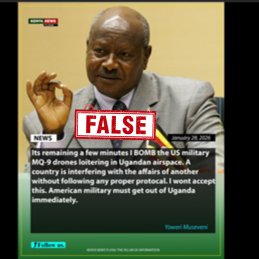
Against this backdrop, a viral social media graphic claiming that President Yoweri Kaguta Museveni had threatened to bomb U.S. military drones allegedly loitering in Ugandan airspace appeared highly alarming. The post, framed as breaking news, quickly attracted attention and reactions online. Given the seriousness of the allegation, it is necessary to closely examine whether the claim is supported by verifiable evidence.
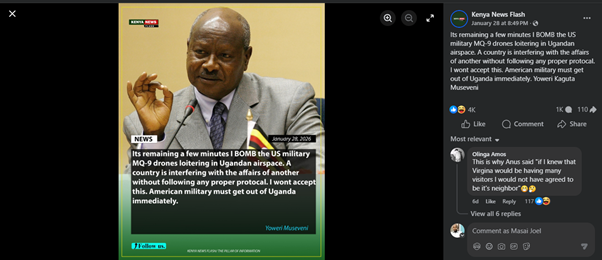
A viral image circulating on Facebook, claims that President Yoweri Kaguta Museveni warned that he would “bomb the US military MQ-9 drones loitering in Ugandan airspace” and demanded that American military forces leave Uganda immediately.
The graphic is branded as “Kenya News Flash” and dated 28 January 2026.
Engagement Statistics
By the time the claim was flagged for verification, the post had attracted thousands of reactions, hundreds of comments, and widespread sharing, increasing the likelihood that audiences could be misled into believing Uganda was on the verge of a military confrontation with the United States.
Findings:
Our investigation shows that this claim is false. There is no credible evidence that President Museveni issued such a threat or that the United States is operating MQ-9 drones unlawfully in Ugandan airspace.
1. No Verified Official Threat or Statement from Museveni
Checks conducted using the InfoVerifier tool found no verified evidence to support the claim that President Yoweri Kaguta Museveni threatened to bomb U.S. MQ-9 drones or ordered American troops to leave Uganda.
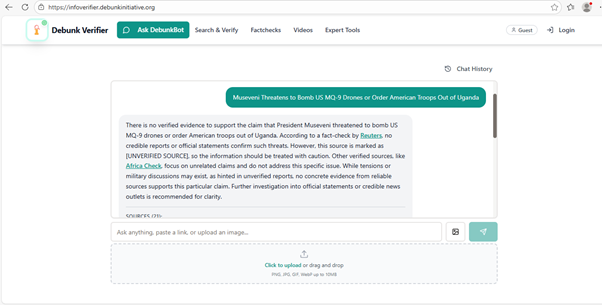
According to the InfoVerifier assessment, no official statements, speeches, or government directives confirm such a threat. The tool references reporting attributed to Reuters but flags the information as “UNVERIFIED SOURCE”, indicating that the claim is not supported by confirmed or primary evidence.

InfoVerifier further notes that while broader discussions about military cooperation or regional security may exist in unverified online commentary, no credible reporting or official communication substantiates this specific allegation.
Given the gravity of a presidential threat against foreign military assets, such an announcement would normally be communicated through formal government channels and widely covered by reputable international media. The absence of such confirmation strongly indicates that the claim is unfounded.
2. No Evidence of Unauthorised US MQ-9 Drone Operations
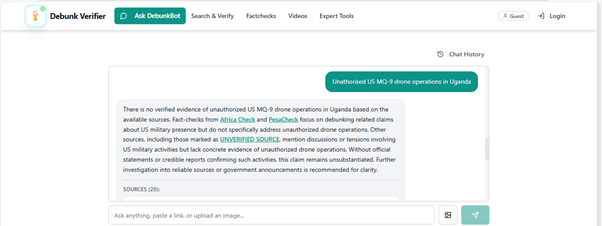
InfoVerifier further indicates that no official statements from the Ugandan government, the Uganda People’s Defence Forces (UPDF), or the United States government confirm the existence of unauthorised drone operations. In the absence of formal government announcements or credible reporting by established international media, the claim remains unsubstantiated.
Without verified documentation or authoritative confirmation, allegations that U.S. MQ-9 drones operating illegally in Uganda cannot be treated as factual and should be approached with caution.
3. Absence of Diplomatic Fallout or Media Coverage
A credible threat by Uganda’s president against U.S. military assets would constitute a major diplomatic event. In comparable situations involving Uganda–U.S. tensions in 2026, genuine incidents have followed a clear and traceable pattern: an identifiable trigger, rapid media coverage, and official diplomatic responses.
A relevant example occurred in January 2026, when Uganda’s Chief of Defence Forces, Muhoozi Kainerugaba, published a series of tweets directed at the U.S. Embassy in Kampala. In the posts, Muhoozi accused the embassy of interfering in Uganda’s internal affairs and used language that was widely interpreted as hostile.
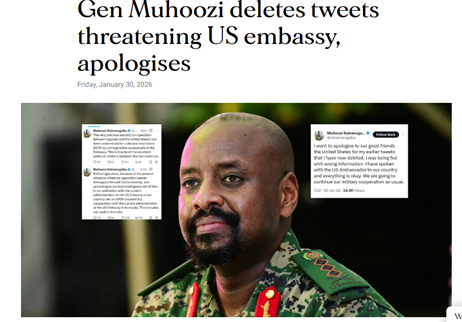
According to reports, the tweets quickly attracted international attention, prompting Muhoozi to later delete the posts and issue an apology, with the Uganda People’s Defence Forces distancing themselves from the remarks. The episode was widely covered by regional and international media, establishing a clear timeline from the initial social media posts to official damage control.
The incident escalated further when Jim Risch, Chair of the U.S. Senate Foreign Relations Committee, publicly warned that Muhoozi had “crossed a red line” and called for a review of U.S.–Uganda security cooperation, including the possibility of sanctions. These responses were formally reported and attributed, leaving a verifiable public record of diplomatic fallout.
Commander @mkainerugaba has crossed a red line and now the U.S. must reevaluate its security partnership, which includes sanctions, and military cooperation with Uganda. The president’s son, and likely successor, cannot just delete tweets and issue hollow apologies. The U.S. will… https://t.co/ObIVkkYNPp
— Senate Foreign Relations Committee Chairman (@SenateForeign) January 30, 2026
By contrast, the viral claim that President Yoweri Kaguta Museveni threatened to bomb U.S. MQ-9 drones or ordered American forces to leave Uganda shows none of these characteristics. There is no identifiable originating statement, speech, or post; no follow-up clarification or retraction; and no reaction from:
- U.S. lawmakers or government agencies
- Uganda’s Ministry of Foreign Affairs
- International or regional news organisations
Checks using the InfoVerifier tool confirm that there are no verified statements from either Ugandan or U.S. officials addressing such a threat. When compared with the Muhoozi episode, where a single set of tweets triggered immediate diplomatic engagement and extensive media coverage, the absence of any comparable response strongly suggests that the alleged Museveni threat did not occur.
Source & Context Verification
1. Reverse Image Search Confirms the Photo Dates Back to 2011
A reverse image search conducted on the photograph of President Yoweri Kaguta Museveni used in the viral graphic shows that the image is not recent and has been in circulation for more than a decade.
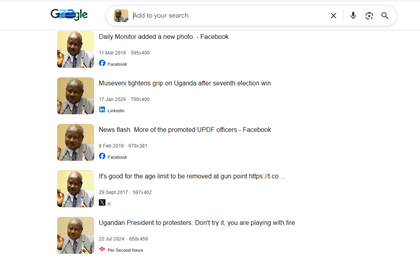
The image appears in online records and publications dating back to at least 2011, long before the events described in the viral post. In its earlier appearances, the photograph is linked to unrelated meetings and public engagements and carries no connection to U.S. military drones, airspace violations, or diplomatic disputes involving the United States.
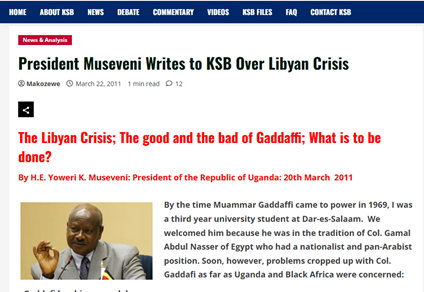
This confirms that the image was recycled from an archival context and repurposed to support a new and unrelated claim. The reuse of an old photograph to present a situation as current or “breaking news” is a well-documented misinformation tactic, particularly in political content shared on social media.
The significant age of the image further undermines the credibility of the claim, as a genuine presidential threat of this nature would be expected to be accompanied by contemporary visuals, verifiable footage, or coverage tied to a specific and recent event.
2. About the source “Kenya News Flash”
The viral graphic is attributed to a Facebook page known as Kenya News Flash, which has previously been associated with the circulation of misleading and unverified content, often presented in the format of breaking news.

The page frequently publishes graphics styled to resemble legitimate news alerts, using:
- “Breaking News” banners
- Sensational headlines
- Images of prominent political figures
However, these posts often lack basic journalistic markers, including attribution to reporters, links to original reporting, official statements, or citations from credible institutions.
In this case, the Kenya News Flash post provides no verifiable source for the alleged statement attributed to President Museveni. There is no accompanying link to an official government communication, no reference to a speech or press conference, and no corroboration from reputable Ugandan, regional, or international media outlets.
Given this track record, claims originating from Kenya News Flash, especially those alleging serious diplomatic or military actions, require independent verification before being treated as credible. In this instance, no such verification exists.
3. Language Inconsistent with Official Communication:
The wording used in the graphic, particularly phrases such as “It’s remaining a few minutes I BOMB…” does not align with the formal tone typically used in presidential statements or official diplomatic communication, further undermining its credibility.
Methodology:
To verify this claim, we applied a multi-step fact-checking process combining digital forensic tools, source evaluation, and contextual analysis:
Use of the InfoVerifier Tool
We used the InfoVerifier tool to conduct keyword and phrase searches related to the alleged threat, including queries referencing President Museveni, U.S. MQ-9 drones, Ugandan airspace, and Uganda–U.S. military relations. InfoVerifier was also used to assess whether any verified reporting, official statements, or institutional responses supported the claim. Results showed no confirmed or primary-source evidence substantiating the allegation, with some references flagged as unverified sources.
Reverse Image and Visual Verification
We conducted reverse image searches on the photograph of President Museveni used in the viral graphic. The image was traced to online uses dating back to at least 2011, where it appeared in unrelated contexts. This confirmed that the photograph was archival and had been reused to present the claim as current.
Source Credibility Assessment
We evaluated the credibility of the originating source, the Facebook page “Kenya News Flash,” by reviewing its posting patterns and sourcing practices. The page frequently publishes content styled as breaking news but often without verifiable sources or journalistic attribution, necessitating independent verification of its claims.
Comparative Contextual Analysis
To assess whether the alleged threat generated any diplomatic fallout, we compared it with a documented 2026 incident involving tweets by Uganda’s Chief of Defence Forces, Muhoozi Kainerugaba, which provoked public responses from U.S. lawmakers and widespread international media coverage. No comparable diplomatic or media response was found in relation to the Museveni drone claim.
Search for Corroboration in Credible Media
We searched reputable Ugandan, regional, and international media outlets for any reporting confirming the alleged threat or diplomatic escalation. No such coverage was found.
Verdict: False
The claim that President Yoweri Kaguta Museveni threatened to bomb U.S. MQ-9 drones and ordered American forces to leave Uganda is false. There is no official statement, credible reporting, or verified evidence supporting the allegation. The viral graphic appears to be fabricated and misleading.
This fact-check/story was produced by Masai Joel with support from The Debunk Media Initiative and BBC Media Action.