

UNVERIFIED: Viral Post Claims Ugandans Will Lose Land After 2026 Unless They Vote Bobi Wine

As Uganda moves closer to the 2026 general elections, politically charged content continues to circulate widely on social media, often designed to provoke fear, urgency, and emotional reactions.
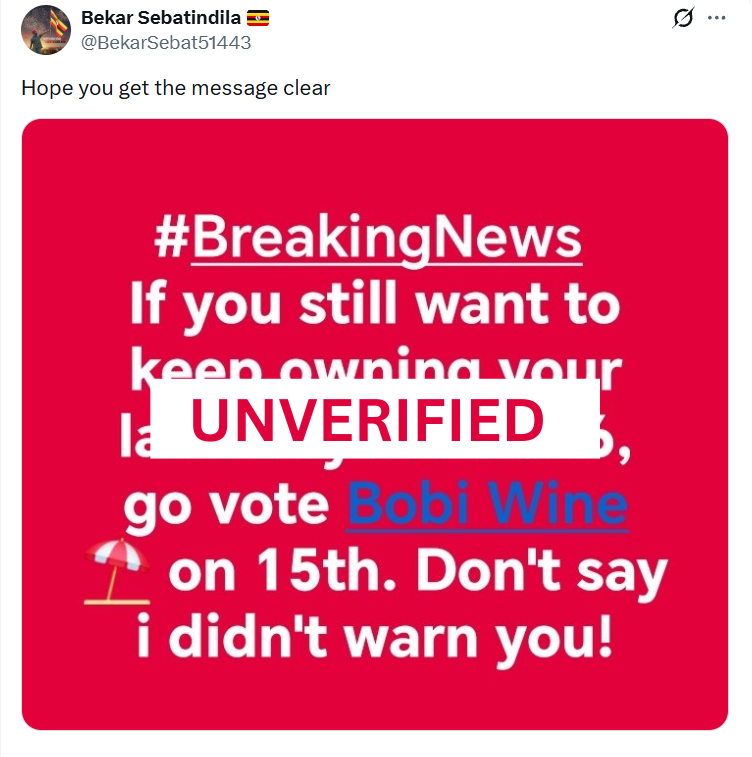
One such post, shared on X (formerly Twitter) by an account using the handle @BekarSebat51443, claims that Ugandans who wish to “keep owning their land beyond 2026” must vote for opposition leader Robert Kyagulanyi Ssentamu, popularly known as Bobi Wine. The post concludes with a warning: “Don’t say I didn’t warn you.”
Hope you get the message clear pic.twitter.com/ww3wDtinHR
— Bekar Sebatindila 🇺🇬 (@BekarSebat51443) January 7, 2026
At the time of review, the post had attracted more than 12,000 views, over 600 likes, and had been widely reposted, indicating significant reach and engagement. The message is presented in a bold “Breaking News” graphic style, implying urgency and authority. However, it does not cite any law, government policy, court ruling, or official statement to support the claim that land ownership in Uganda is under threat after 2026, should it not be Kyagulanyi who is announced for the presidency.
Lack of Evidence
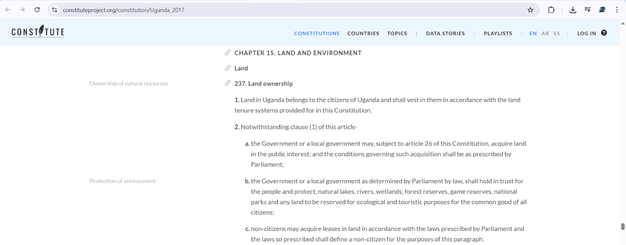
A review of Uganda’s constitutional and legal framework shows that land ownership rights are protected under the 1995 Constitution of Uganda, which states in Article 237(1) that land belongs to the citizens of Uganda and is vested in them under recognised tenure systems.
These protections are further reinforced by the Land Act (Cap. 227), which operationalises constitutional land rights and regulates customary, freehold, mailo, and leasehold tenure systems.
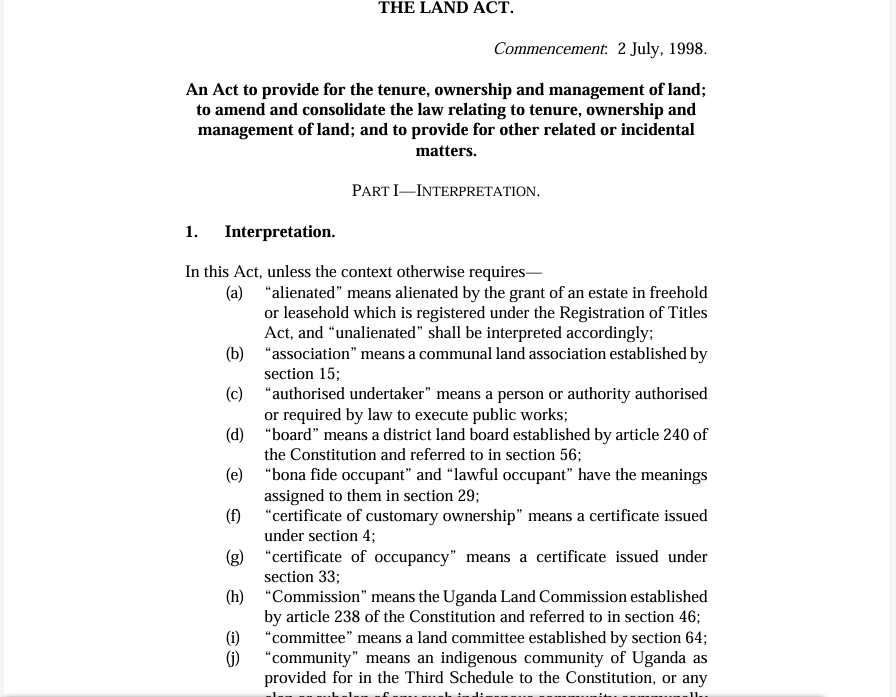
Neither the Constitution nor the Land Act links land ownership rights to election outcomes or to the victory of any political candidate.
No official government communication, parliamentary proposal, or judicial decision suggests that Ugandans will lose land ownership rights after 2026.
Similarly, a search across Bobi Wine’s verified social media accounts, public speeches, and party policy positions reveals no statement in which he claims that voting for him is the only way to safeguard land ownership in Uganda.
The viral post, therefore, offers no factual basis for its warning and relies entirely on implication and fear-driven political messaging.
Emotional and Social Impact
The post has generated strong emotional reactions among users, with some interpreting it as a serious warning about land grabbing and others dismissing it as political propaganda.
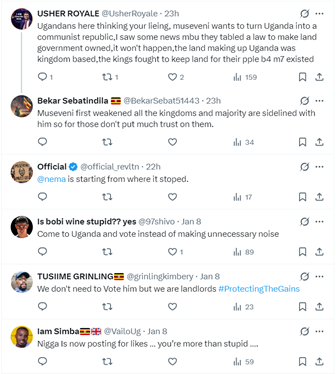
In the comment section, users expressed sharply divided opinions, with some rejecting the claim outright and accusing the post of spreading fear and seeking attention, while others questioned government intentions regarding land and political power.
Several commenters referenced Uganda’s historical land systems and the role of kingdoms, while others argued over whether political leaders could be trusted to protect citizens’ property rights. Personal attacks, sarcasm, and dismissive remarks were also common, shifting the discussion away from evidence-based debate. Rather than clarifying the original claim, the exchanges reflected deep mistrust, political hostility, and emotional reactions, demonstrating how unverified political posts can quickly inflame divisions and distract from factual scrutiny.
Contextual Red Flags
The post provides no timeline, policy reference, or explanation of how land ownership would allegedly be lost after 2026. Authentic warnings about land policy are usually tied to specific bills, court rulings, constitutional amendments, or official announcements, none of which are referenced here.
Notably, the post concludes with the phrase “Don’t say I didn’t warn you.” Such wording is considered a rhetorical fear appeal rather than a factual statement. It implies insider knowledge without offering any evidence or sources, and is commonly associated with speculative or manipulative political messaging.
Claims that link personal property rights directly to voting choices are particularly serious and would normally provoke widespread media coverage and official clarification. No such coverage or response was observed following the circulation of this post.
Our assessment also shows that the post fits a recurring election-period pattern in which fears, including those related to land rights, voting outcomes, or government actions are circulated online to mobilise or intimidate voters without presenting verifiable evidence. Such digital misinformation and unverified political content have been widely noted as a growing concern in Uganda’s 2026 election environment, where fabricated posts, manipulated visuals, and misleading claims have circulated on social media before official verification or reporting.
Tools / Methods Used to Verify the Claim
To assess the accuracy of the viral post, we:
- Reviewed the original X post to analyse its wording, presentation, and framing.
- Conducted keyword searches across Bobi Wine’s verified social media platforms, including X, Facebook, and YouTube, for any matching or similar statements.
- Searched Ugandan media outlets for reports related to land ownership being threatened after 2026.
- Reviewed Uganda’s constitutional and statutory land ownership provisions for relevant policy changes.
- Analysed user engagement and comment reactions to understand the post’s impact and spread.
None of these steps produced evidence supporting the claim.
Verdict
The claim that Ugandans will lose their land after 2026 unless they vote for Bobi Wine is unverified and misleading. There is no legal, political, or institutional evidence to support the warning, and the post should not be treated as factual.
Beyond being unverified, the claim is also presented as a matter of personal opinion rather than as a factual statement. The post does not reference any law, policy, court ruling, or official source, and instead relies on subjective interpretation and political belief. Its wording reflects the author’s personal judgement about future political outcomes rather than verifiable information. As a result, the warning cannot be treated as a factual claim about Uganda’s land policy, but rather as an individual’s political viewpoint.
Readers are encouraged to rely on official legal documents, credible journalism, and verified political statements when assessing claims about land ownership and electoral consequences.