

FACT CHECK: Claim that Uganda is “Bleeding Genocide” in 2026 is Misleading

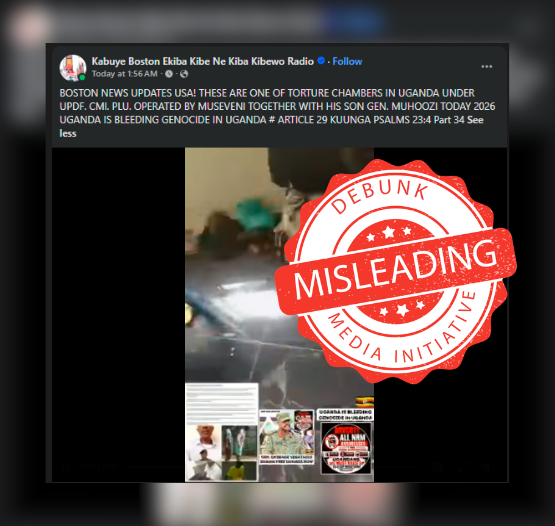
The Claim
A Facebook post published by Kabuye Boston Ekiba Kibe Ne Kiba Kibeewo Radio claims that leaked videos show “torture chambers” in Uganda operated by the UPDF, CMI, and PLU. The caption states: “TODAY 2026 UGANDA IS BLEEDING GENOCIDE IN UGANDA.” It further alleges these facilities are directly operated by President Yoweri Museveni and his son, Gen. Muhoozi Kainerugaba.
Background Context:
This post surfaced following intense public debate regarding the detention and alleged torture of opposition figures in security facilities:
- The Mabonga Leaks: On September 30, 2026, former UPDF officer Lt. Herbert Matanda Mabonga released videos allegedly recorded inside a military safehouse. The footage purports to show detained opposition figures, including Sam Mugumya and Muwanga Kivumbi. Mabonga alleged widespread arbitrary arrests, disappearances, and torture. However, local reporting by Pulse Uganda noted that the exact location, dates, and full authenticity of the footage had not yet been independently verified at publication.
- Human Rights Documentation: Human rights organizations have documented severe abuses in 2026. Human Rights Watch reported that opposition figure Muwanga Kivumbi was forcibly disappeared to an undisclosed location in July 2026 and later alleged he was tortured. Amnesty International also reported arbitrary arrests, incommunicado detentions, and the killing of at least 16 people by security forces surrounding the January 2026 elections.
These reports confirm a severe crisis of political repression and misconduct by security forces. However, they do not establish that a genocide is occurring.
Key Findings
The central assertion that “Uganda is bleeding genocide” is not supported by international law or the evidence reviewed:
- The Legal Definition: Under Article II of the 1948 UN Genocide Convention, genocide requires a proven, specific intent to destroy, in whole or in part, a national, ethnical, racial, or religious group.
- Political Groups Are Excluded: The United Nations explicitly clarifies that protected groups under the Genocide Convention do not include political groups. Therefore, targeting people on political grounds can constitute persecution as a crime against humanity when the additional requirements under Article 7 of the Rome Statute are met. Similarly, acts such as murder, torture, imprisonment and enforced disappearance can constitute crimes against humanity when committed as part of a widespread or systematic attack directed against a civilian population. not genocide.
- Targeting Logic: Evidence documented by Amnesty International in 2026 indicates that many of the people subjected to arbitrary arrest, detention and alleged torture were targeted because of their political affiliation or perceived support for the opposition National Unity Platform (NUP). Amnesty International documented 17 cases of arbitrary arrest and stated that the victims were arrested on the basis of their political affiliation, with some questioned specifically about their support for NUP or its presidential candidate Robert Kyagulanyi.
The evidence reviewed for this fact-check does not establish that these victims were targeted with the specific intent to physically destroy a national, ethnic, racial or religious group, which is a required element of genocide under the Genocide Convention.
- The Weight of the Abuses: Labelling the claim as misleading does not diminish the seriousness of the alleged abuses. Murder, torture and enforced disappearance are grave violations that may constitute international crimes when the relevant legal requirements are met. However, genocide is a distinct crime under international law and requires additional elements, including specific intent to destroy a protected group. The seriousness of other international crimes should not be measured simply by whether they meet the legal definition of genocide.
Methodology
We reviewed the original social media post, including its caption and accompanying material, and identified the specific assertion being made about genocide.
The investigation then:
- Examined the relevant provisions of international law governing genocide and crimes against humanity.
- Reviewed 2026 documentation from credible human-rights organizations concerning the individuals and incidents referenced in the post.
- Cross-checked the reported circumstances of the alleged abuses against the legal criteria for genocide.
- Distinguished documented facts from allegations and from the language used by the social media post.
- Assessed whether the available evidence was sufficient to substantiate the central claim that Uganda was experiencing genocide in 2026.
Verdict: MISLEADING
The Facebook post mischaracterizes documented allegations of political repression, torture, and enforced disappearances by labeling them as “genocide.” While major human rights organizations document severe violations against political opposition in Uganda, the evidence does not show the specific intent to destroy a national, ethnic, racial, or religious group required under international law.