

FALSE GENERALIZATION: Urban Charcoal Consumption Data Misapplied to All Ugandans

Claim
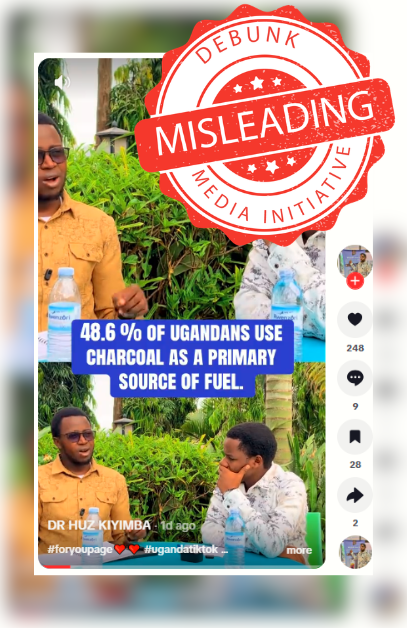
A TikTok video posted by the account @drhuzmedia shows a speaker claiming that “48.6% of Ugandans use charcoal as a primary source of fuel”. In the same clip, the creator goes further to assert that developed countries no longer use wood or charcoal for heating or energy.
Brief Background
Public debates about cutting down trees, protecting the environment, and switching to clean energy are currently hot topics in Uganda. These discussions have become even sharper as security forces actively enforce Presidential Executive Order No. 3 of 2023, which banned commercial charcoal production and trade across Northern Uganda, West Nile, Karamoja, and the Teso region.
As enforcement operations by agencies like the Uganda Police Force squeeze the charcoal supply and spark debates over the rising cost of gas and electricity, people frequently quote energy statistics online. However, numbers are often pulled out of official survey reports, such as data releases from the Uganda Bureau of Statistics (UBOS), without key details. On platforms like TikTok, this causes creators to take a statistic meant only for town households and wrongly claim it represents every Ugandan in the country.
Findings:
Our investigation reveals that the claim conflates two distinct demographic and geographical metrics:
- Geographic Scope Discrepancy (Urban vs. National):
- The Reality: Data published by the Uganda Bureau of Statistics (UBOS) in official releases including the National Population and Housing Census (NPHC) and the Uganda National Household Survey (UNHS), shows that energy usage varies drastically by location. The 48.6% figure originates directly from UBOS survey indicators measuring urban household primary fuel usage.
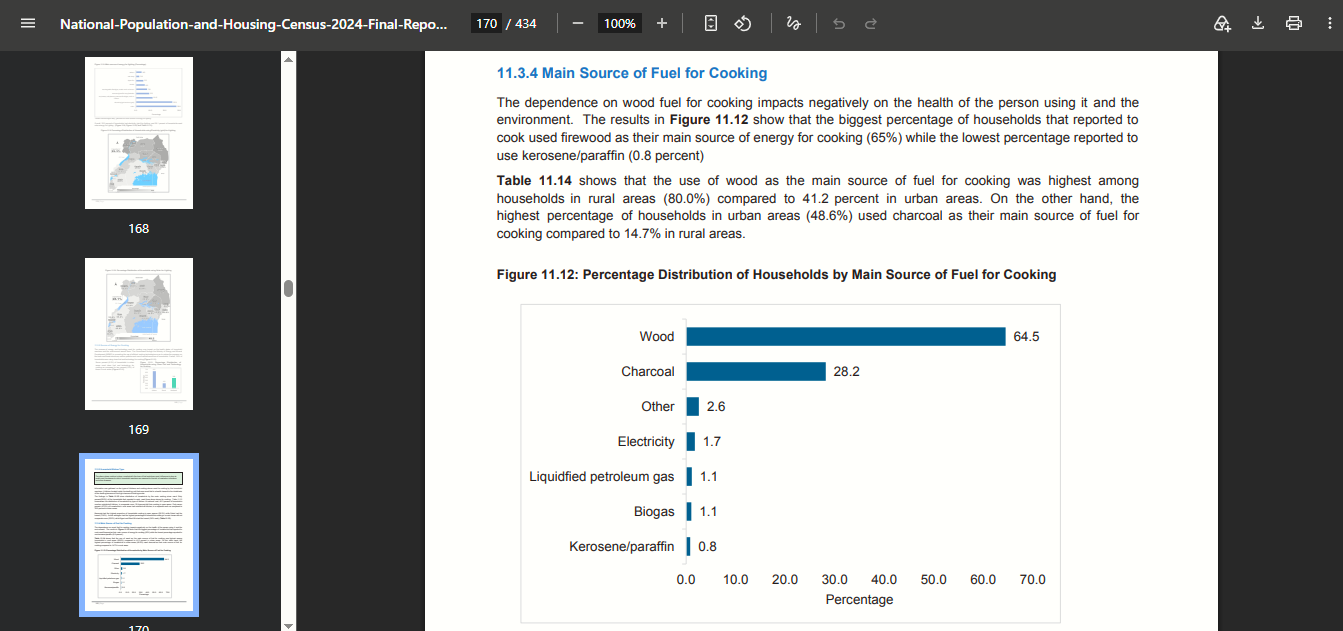
- The Misapplication: The figure 48.6% refers strictly to a sub-segment of urban households or specific urban survey domains, where charcoal reliance is concentrated. Applying an urban percentage to all Ugandans ignores the nationwide reliance on firewood (which accounts for over 64% of national household usage).
- Unit of Measurement Discrepancy (Households vs. Individuals):
- The Reality: Socio-economic and census data collected by bodies like UBOS measure energy choices by households (dwelling units), not by counting every individual person.
- The Misapplication: Equating household percentages directly to individual citizens (“Ugandans”) introduces statistical distortion, as household sizes vary significantly across urban and rural demographics.
Methodology / How We Found the Findings
To verify this claim:
- We checked official government numbers: We compared the figures in the video against official reports from the Uganda Bureau of Statistics (UBOS), including the latest National Population and Housing Census and the Uganda National Household Survey (UNHS).
- We separated town numbers from village numbers: We looked at how cooking fuels (charcoal, firewood, and gas) are used in towns versus villages to see whether 48.6% applies to the whole country or just town households.
Verdict: FALSE GENERALIZATION
The claim that 48.6% of Ugandans rely on charcoal as their primary cooking fuel is misleading. The figure represents a specific metric anchored on urban households, not the entire national population. On a national level, firewood, not charcoal, remains the primary source of cooking fuel for the majority of Ugandans.