

Misleading: US Treasury Yields Were Not the Only Factors Behind the Ugandan Shilling’s Depreciation

CLAIM
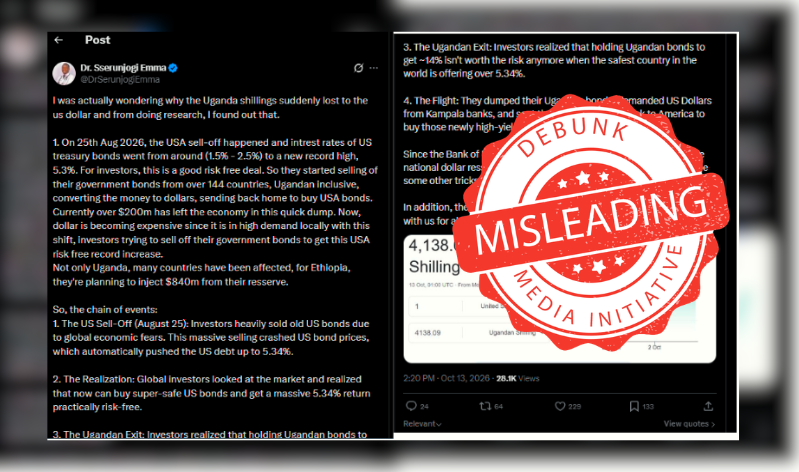
An X user by the handle @DrSerunjogiEmma claims that a US Treasury bond sell-off on August 25, 2026, caused foreign investors to withdraw money from Uganda’s government securities market and convert their investments into US dollars, leading to the depreciation of the Ugandan shilling.
The user argues that the sell-off pushed US Treasury yields to 5.34%, making American government bonds more attractive to investors than Ugandan securities.
BRIEF BACKGROUND
The claim emerged amid a sharp depreciation of the Ugandan shilling against the US dollar. The currency weakened further in October, briefly reaching Shs4,500 per dollar on October 23, its weakest level in 33 years, according to the Daily Monitor.
The post attributes the depreciation largely to foreign investors moving their money from Ugandan government bonds into US Treasury securities. It also suggests that the Bank of Uganda’s reluctance to sell its foreign-exchange reserves has allowed the shilling to continue weakening.
ENGAGEMENTS
At the time of verification, the post had garnered over 28k views, 229 likes, 64 reposts, and generated significant public debate.

The post author, Dr. Sserunjogi Emma (@DrSerunjogiEmma), actively engaged in the comment section to defend his thesis. When questioned on the source of the “$200 million” offshore exit figure, the author shared a Bloomberg excerpt citing a Citigroup estimate of more than $200 million leaving Ugandan markets over a two-week window.
When challenged on why investors would abandon 14% Ugandan bond yields for a 5.34% US Treasury yield, the author argued that institutional managers preferred risk-free US assets over higher-yielding emerging market debt.
Several commentators including @SmlpOfficial, @chrispine7715, @YMate90, and @hadijerhariss pointed out that neighboring currencies like the Kenyan and Tanzanian shillings were not experiencing equivalent depreciation, asking if domestic factors were the real cause. In response, the author dismissed the regional currency strength as temporary, describing it as a “spike and hit kind” occurrence.
These exchanges highlighted differing views about the causes of the shilling’s depreciation. We therefore investigated the claim to assess whether the available economic data supported the suggested link between the US Treasury bond sell-off, capital outflows from Uganda and the weakening of the Ugandan shilling.
FINDINGS
The US Treasury bond market experienced elevated yields in August 2026, but the available evidence does not establish that a sudden increase to 5.34% on August 25 triggered the shilling’s depreciation.
According to the US Department of the Treasury’s daily par yield curve data, the 30-year Treasury yield stood at 5.31% on August 17 and 5.28% on August 18. The 10-year yield was 4.72% and 4.71% on those respective dates. On August 25, the 10-year yield stood at 4.64%, while the 30-year yield was 5.17%. These figures show that yields varied by bond maturity and that the 10-year and 30-year yields did not reach 5.34% on August 25.
The post’s claim that US Treasury yields rose from approximately 1.5–2.5% to 5.34% on August 25 is not supported by the official daily par yield curve data. Treasury yields vary by bond maturity, and the post does not specify which maturity the 5.34% figure refers to. The official data show that the 10-year and 30-year yields were 4.64% and 5.17%, respectively, on that date. The data therefore do not support the specific yield figures cited in the post for August 25, 2026.
Uganda’s exchange-rate data also show that the depreciation continued beyond August. According to the Ministry of Finance’s August 2026 economic performance report, the shilling depreciated by 0.7% in August, averaging Shs3,730.25 per dollar compared with Shs3,704.51 in July.
The ministry’s September 2026 Performance of the Economy Report recorded a further depreciation of 3.7%, with the shilling averaging Shs3,868.87 per dollar. It attributed the depreciation partly to rising global oil prices and US Treasury yields, which contributed to global dollar strength, alongside seasonal foreign-currency demand and speculation in the local market.
These figures show that the shilling’s depreciation accelerated in September. However, monthly averages alone cannot establish whether an event on August 25 caused the subsequent movement.
In a statement to Parliament on October 27, 2026, the Ministry of Finance identified international financial conditions and episodes of foreign investors selling domestic securities among the factors contributing to pressure on the shilling. It also highlighted rising petroleum costs, increased demand for foreign exchange and reduced earnings from some agricultural exports. The ministry noted that the Bank of Uganda was still assessing the extent to which international financial developments had affected domestic foreign-exchange flows.
This supports the view that global financial conditions and foreign investor activity may have contributed to pressure on the shilling. However, the statement does not establish that the specific Treasury yield cited in the post triggered an outflow of more than $200 million from Uganda on August 25 or that this was the direct cause of the shilling’s depreciation.
Capital outflows and the timing of the claim
The claim also links the shilling’s depreciation to an outflow of more than $200 million from Uganda’s markets. However, reporting by Daily Monitor on October 16 attributed this figure to a Citigroup estimate of capital leaving Uganda’s markets over a two-week period as offshore investors shifted away from local bonds towards dollar assets. The report does not establish the entire amount left on August 25.
The Ministry of Finance’s statement also identified higher returns in advanced economies as a factor that could limit portfolio investment inflows into Uganda. Together with the reported capital outflow estimate, this provides context for the pressure on the shilling, but it does not establish that the reported $200 million outflow occurred on August 25 or was triggered by the specific Treasury yield cited in the post.
The Bank of Uganda’s response provides further context. In its October 2026 Monetary Policy Statement, issued on October 14, the Bank announced that it had raised the Central Bank Rate from 9.75% to 12%. It also confirmed that the Cash Reserve Requirement had increased from 11% to 13.5%, effective September 24.
The statement identified rising interest rates in advanced economies, heightened geopolitical tensions, higher international oil prices and a deteriorating current account deficit among the factors contributing to pressure on the shilling.
The Bank of Uganda’s statement outlines the monetary policy measures it took to address depreciation pressures but does not specify whether the Bank was willing to sell dollar reserves at the time the post was published.
The post also describes the war involving Iran as a minor factor in the shilling’s depreciation. However, the Ministry of Finance’s October 27 statement to Parliament identified higher international petroleum costs and increased foreign-exchange demand from the energy sector as factors contributing to pressure on the shilling. The Bank of Uganda’s October monetary policy statement also identified the conflict in the Middle East, higher global oil prices and tighter international financial conditions as factors intensifying depreciation pressures.
Although these sources do not establish the precise share of the depreciation attributable to the conflict, they show that geopolitical tensions and their effects on global energy prices and financial markets were among the factors identified by Uganda’s economic authorities. Describing the conflict as a minor factor therefore understates the significance these authorities attached to the wider economic pressures associated with it.
Overall, the evidence supports the possibility that rising US Treasury yields and foreign investor outflows contributed to the shilling’s depreciation. However, it does not establish that a single Treasury bond sell-off on August 25 caused the currency to weaken. The post also misrepresents the Treasury yield figures and understates the role of other factors, including rising oil prices, foreign-exchange demand and geopolitical tensions, identified in official economic reporting.
Methodology:
We reviewed the original social media post and identified its key claims concerning US Treasury yields, capital outflows from Uganda, the depreciation of the Ugandan shilling, the Bank of Uganda’s response and the influence of the conflict involving Iran.
To verify the claim about US Treasury yields, we consulted the US Department of the Treasury’s official daily par yield curve data and examined the recorded yields across different bond maturities and dates, including August 25, 2026.
We reviewed the Ministry of Finance’s August and September 2026 economic performance reports to examine exchange-rate movements over the period. We also consulted the Ministry’s October 27, 2026, statement to Parliament and the Bank of Uganda’s October 2026 Monetary Policy Statement to establish the economic factors and policy measures identified by the authorities as relevant to the shilling’s depreciation.
To assess the claim about capital outflows exceeding $200 million, we examined reporting by Daily Monitor that cited a Citigroup estimate. We compared the reported timeframe for the outflows with the date specified in the original post to determine whether the evidence established the claimed timing.
Finally, we reviewed the Ministry of Finance’s statement to Parliament and the Bank of Uganda’s monetary policy statement for information on the effects of geopolitical tensions, global oil prices and international financial conditions on Uganda’s foreign-exchange market. We compared these sources with the explanations presented in the original post.
VERDICT
Misleading.
The claim identifies rising US Treasury yields and foreign investor outflows as possible contributors to pressure on the Ugandan shilling. However, the official US Treasury data do not support the claim that yields reached 5.34% on August 25, 2026, and the available evidence does not establish that a Treasury bond sell-off on that date triggered the reported capital outflows of more than $200 million.
Uganda’s Ministry of Finance and the Bank of Uganda identified several factors contributing to pressure on the shilling, including global financial conditions, higher oil prices, increased demand for foreign exchange and geopolitical tensions in the Middle East. However, the available evidence does not establish th e precise contribution of each factor or prove the specific causal sequence described in the post.