

Missing Context: Low Inflation Alone Does Not Show Household Incomes Were Protected

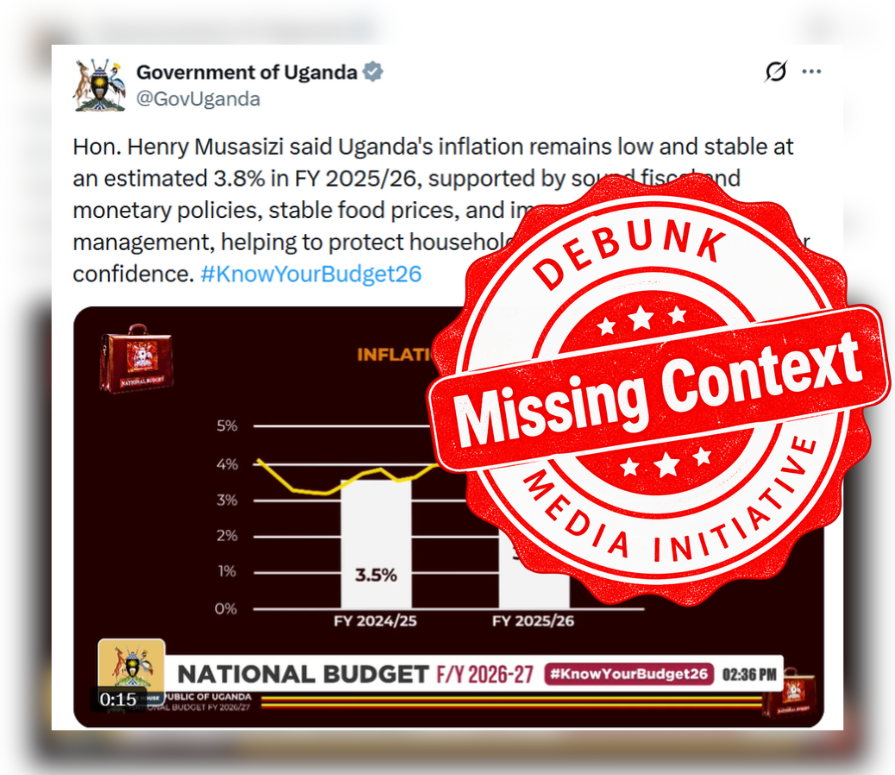
Claim
The Government of Uganda said inflation remained low and stable at an estimated 3.8% in FY2025/26, and linked this price stability to protecting household incomes and boosting investor confidence.
The same position was repeated in a Government of Uganda post on X on 11 June 2026, alongside the Budget Speech.
Background
On 11 June 2026, Finance Minister Henry Musasizi presented the FY2026/27 Budget Speech at Kololo Independence Grounds. In paragraph 17, he said average inflation in FY2025/26 was estimated at 3.8%, compared with 3.5% the previous financial year.
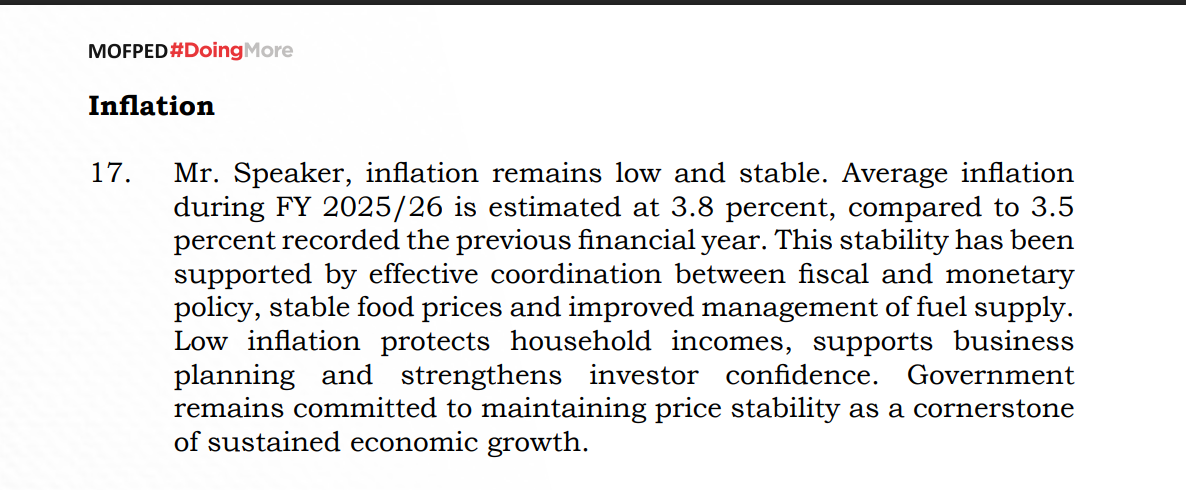
He attributed the stability to coordination between fiscal and monetary policy, stable food prices and improved fuel supply management.
The Government repeated the message in an X post on the same day, saying the estimated 3.8% inflation was helping to protect household incomes and boost investor confidence. The post provides a clear public statement of the link this fact-check examines.
This fact-check asks two questions: Was the inflation statement accurate when it was made? And does low inflation, on its own, demonstrate that household incomes were protected?
What We Found
1. The 3.8% figure was an estimate, not the final figure.
The Ministry of Finance put average headline inflation for FY2025/26 at 3.3%, down from 3.5% in FY2024/25. UBOS reported the same financial-year average in its June 2026 CPI release. The Budget Speech’s 3.8% was an estimate made before the year ended, so the final figure came in lower than the Minister said.
The 12-month rate in June 2026 was 3.7%. That measures price changes over the 12 months to June, not the average for the financial year.
2. Inflation rose in the months after the speech
UBOS data show annual headline inflation climbing after June:
- June 2026: 3.7%
- July 2026: 4.0%
- August 2026: 4.1%
- September 2026: 4.6%
- October 2026: 5.8%
October’s rate was the highest in more than three years. The Bank of Uganda’s (BoU) 5% medium-term target applies to core inflation rather than headline inflation. Core inflation was 4.4% in October, still under the target. In its November 2026 Monetary Policy Statement, issued on 9 November, the BoU projected that over the next 12 months core inflation would average 6.0% to 6.5% and headline inflation 7.5% to 8.0%, both above the 5% target. That raised its October projections of 5.5% to 6.0% for core and 7.0% to 7.5% for headline.
These increases came after the speech. They do not show that the June figures were wrong.
3. The drivers the Minister credited: what we can and cannot say
Food. When the speech was delivered, the evidence supported the Minister. The Ministry’s June report recorded food crop inflation of 0.0%. By October, UBOS reported food crops and related items inflation of 10.7%, up from 4.5% in September, driven by dry beans, tomatoes, sweet potatoes, matooke and pineapples. The BoU has pointed to adverse weather, including the delayed effects of drought in the first half of 2026, among the pressures on prices.
Fuel. Energy, fuel and utilities (EFU) inflation was already rising around the time of the speech, from 9.1% in May to 11.9% in June, according to the Ministry’s report. It reached 14.5% in September and 15.4% in October, with petrol prices up 34.3% and diesel up 49.2% over the year. UBOS and the BoU linked the rises to higher global oil prices tied to the Middle East conflict and a weaker shilling. The shilling averaged about Shs 4,170 to the dollar in October, roughly 9.9% weaker than the Shs 3,796 assumed in the 2026/27 budget.
Later external shocks do not prove that the price stability reported in June was not real. But EFU inflation was already in double digits by June, and the later data show how exposed prices were to oil and exchange-rate movements.
4. Headline inflation may not reflect the pressure faced by food-heavy households
In UBOS’s CPI, food and non-alcoholic beverages carry a weight of 27.05%. Those weights come from the 2016/17 household survey, and UBOS’s CPI baskets are urban.
The Uganda National Household Survey (UNHS) 2023/24 found that food and non-alcoholic beverages made up 44.2% of household spending nationally, and more than half in rural areas. The two figures are not directly comparable, because they come from different surveys, years and populations. But both show that food matters more in poorer and rural household budgets than the headline weight suggests.
In October, UBOS recorded the highest regional inflation rate among low-income households in Kampala, at 6.7%, against 5.8% nationally. Food crops are only one part of food spending, so the 10.7% figure cannot be read as the rise in any one household’s food bill.
5. Low inflation does not show that incomes kept pace
A positive inflation rate means prices are still rising, only more slowly. Whether purchasing power is protected also depends on what happens to incomes.
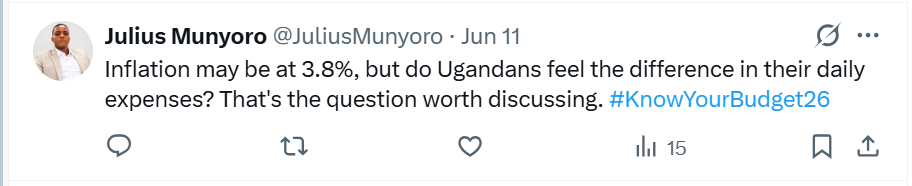
That distinction was also raised in responses to the Government’s post on X, with one commenter questioning whether low inflation could be taken to mean that households were actually better off. The question is whether available income data supports that conclusion.
We found no published household income or wage growth data for FY2025/26 that would settle the question. GDP per capita is sometimes used as a broad indicator of average economic wellbeing, but it does not show what typical households earned or whether their incomes kept pace with prices.
The latest survey figure, from the UNHS 2023/24, is median monthly cash earnings of UGX 200,000 for people in paid employment. That is a level, not a growth rate, and it predates the period in question.
The available data therefore does not establish that household incomes were protected. Low inflation can help limit the erosion of purchasing power, but the inflation rate alone cannot demonstrate that households’ incomes kept pace with the prices they faced.
Methodology:
We reviewed the FY2026/27 Budget Speech (11 June 2026) and compared its inflation estimate with the outturn reported by the Ministry of Finance and in UBOS’s June 2026 CPI release. We used the Ministry’s June 2026 Performance of the Economy Report, as reported by New Vision, for June food and energy inflation. We examined UBOS’s monthly CPI publications for June to October 2026 (for example, October) and the BoU’s November 2026 Monetary Policy Statement, including the scope of its 5% target and the change from its October projections.
We used the UBOS CPI weights and the UNHS 2023/24 to compare the CPI basket with household spending. For income, we looked for wage, earnings and household income data and reviewed Ministry of Finance per capita figures and UNHS earnings data.
The Ministry of Finance, Planning and Economic Development was contacted for comment on 17 November 2026. At the time of publication, no response had been received.
Verdict: Missing Context
The Government’s 3.8% inflation figure was an estimate made before FY2025/26 ended, and the final average headline inflation was lower at 3.3%. The figure therefore was not false when it was presented as an estimate.
However, the Government’s claim goes beyond the inflation figure itself by saying that low inflation protects household incomes. Our review found no recent, nationally representative data showing that household incomes or wages increased enough during FY2025/26 to keep pace with prices.
Low inflation means prices are rising more slowly; it does not mean that prices are falling or that household incomes have necessarily kept pace. The available evidence also shows that food and fuel prices later rose sharply, while food accounts for a larger share of spending among poorer and rural households.
The Government’s claim therefore needs context: the inflation rate supports a statement about the pace of price increases, but by itself does not demonstrate that household incomes were protected.