

Missing Context: Uganda’s 80.9% Domestic Revenue Figure Excludes Major Government Obligations

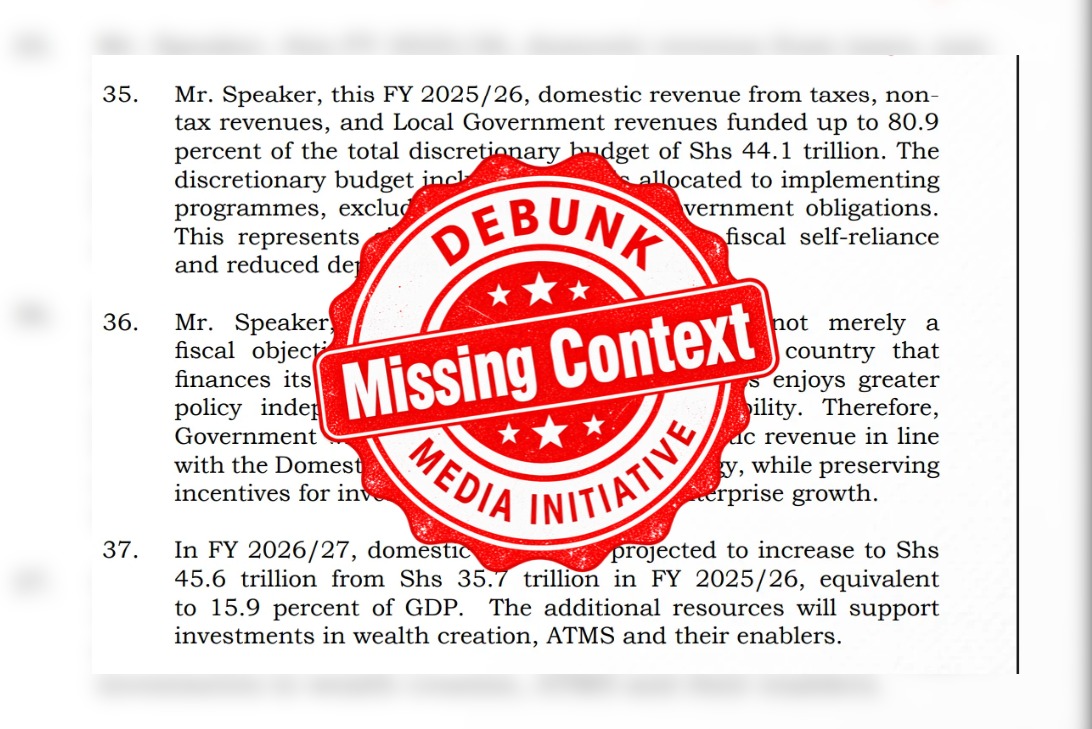
The claim
The Ministry of Finance stated in June 2026 that domestic revenue funded over 80% of Uganda’s discretionary budget in FY2025/26, describing this as significant progress towards fiscal self-reliance.
Background
On 11 June 2026, Finance Minister Henry Musasizi presented the FY2026/27 Budget Speech in Parliament. In paragraph 35, he said that domestic revenue from taxes, non-tax revenue and Local Government revenue had funded 80.9% of the Shs44.1 trillion discretionary budget in FY2025/26 (July 2025 to June 2026).
He described this as significant progress towards fiscal self-reliance and reduced dependence on external financing.
The Ministry defines the discretionary budget as funds allocated to implementing government programmes, excluding debt and other Government obligations. This means the Shs44.1 trillion figure does not cover the entire national budget, but a portion from which those obligations have been excluded.
Findings
1. The 80.9% figure is mathematically correct
The Budget Speech states that domestic revenue was projected at Shs35.7 trillion in FY2025/26 and that the discretionary budget was Shs44.1 trillion.
Dividing Shs35.7 trillion by Shs44.1 trillion gives approximately 80.9%.
The Ministry therefore correctly calculated that domestic revenue accounted for 80.9% of the discretionary budget it defined for FY2025/26.
2. However, the 80.9% figure excludes debt and other Government obligations
The FY2025/26 budget documents also listed Shs11.33 trillion in interest payments, Shs10.03 trillion for domestic debt refinancing, Shs4.986 trillion for debt repayments, Shs493 billion for repayment of domestic debt to the Bank of Uganda and Shs1.4 trillion for domestic arrears.
These items total approximately Shs28.24 trillion. Subtracting this amount from the Shs72.38 trillion budget leaves about Shs44.14 trillion, which is close to the Shs44.1 trillion discretionary budget stated in the Budget Speech.
This shows that the 80.9% calculation applies to the portion of the budget left after excluding substantial debt payments and other obligations.
3. Uganda is still relying on borrowing to finance the FY2026/27 budget
The FY2026/27 budget continues to rely on borrowing alongside domestic revenue. The Government plans to raise Shs11.97 trillion through domestic borrowing and approximately Shs9.66 trillion through external loans. Together, these account for about 31% of the Shs70.42 trillion financing requirement after excluding the refinancing of existing domestic debt.
The budget also includes Shs2.83 trillion in grants and Shs13.97 trillion to refinance existing domestic debt. These figures show that, although domestic revenue is the largest source of financing, borrowing remains an important part of the Government’s budget.
- Recent revenue performance shows both progress and continued pressure
There is evidence that domestic revenue mobilisation has improved. In June 2026, the final month of FY2025/26, domestic revenue collections reached Shs5.72 trillion, exceeding the monthly target by 18.2%.
However, the beginning of FY2026/27 has not produced uniformly strong revenue performance.
In July 2026, domestic revenue amounted to Shs2.66 trillion against a target of Shs2.90 trillion, resulting in a shortfall of Shs243.16 billion.
In August, collections were Shs2.87 trillion against a target of Shs3.24 trillion, a shortfall of Shs365.68 billion.
The latest available September figures show domestic revenue of Shs2.87 trillion against a target of Shs3.15 trillion, a shortfall of Shs273.67 billion. The Ministry attributed the wider fiscal deficit for the month partly to the revenue shortfall.
During the first quarter of FY2026/27, domestic revenue collections totalled approximately Shs8.40 trillion against a target of Shs9.28 trillion, representing 90.5% of the target. This left a shortfall of about Shs882.51 billion.
5. Domestic revenue is increasing, but borrowing remains part of the financing strategy
The Budget Speech projected domestic revenue of Shs35.7 trillion for FY2025/26, up from Shs32.3 trillion collected in FY2024/25. For FY2026/27, the Government projected domestic revenue of approximately Shs45.96 trillion.
However, the increase in projected revenue has not eliminated the gap between what the Government collects and what it spends.
The share of new financing expected from borrowing has also declined. A comparison of the two budget financing plans shows a reduction from approximately 35% in FY2025/26 to 31% in FY2026/27. This indicates a shift towards greater domestic revenue financing, although borrowing remains a substantial source of funds.
In its August 2026 Article IV assessment, the IMF projected that Uganda’s revenue and grants would amount to 14.6% of GDP in FY2025/26, against government expenditure of 21.7%, leaving a fiscal deficit of 7.1% of GDP. The IMF attributed much of the projected increase in the deficit to higher interest payments. It also noted that financing continued to rely heavily on the domestic market and non-concessional foreign borrowing. Interest payments were projected to absorb almost a third of domestic revenue.
The Government’s own FY2026/27 financing strategy also includes domestic borrowing and concessional financing from development partners and international financial institutions, alongside domestic revenue.
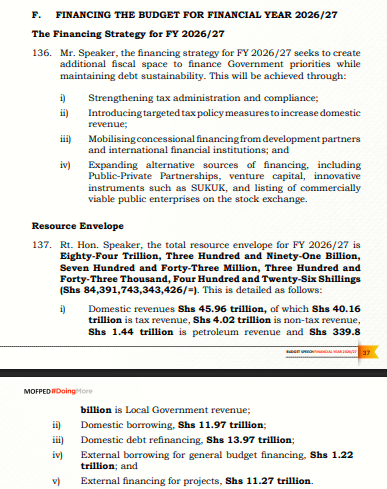
The increase in domestic revenue therefore represents progress, but it has not removed the Government’s need to borrow or seek external financing to meet its spending commitments.
Methodology:
We reviewed the Ministry of Finance’s FY2026/27 Budget Speech and the FY2025/26 budget documents to establish how the Government arrived at the 80.9% domestic revenue financing figure and what expenditure items were included in the discretionary budget.
We independently calculated the percentage by dividing the projected FY2025/26 domestic revenue of Shs35.7 trillion by the Shs44.1 trillion discretionary budget. We also examined the FY2025/26 budget allocations for debt refinancing, debt repayments and domestic arrears to establish which obligations were excluded from the discretionary budget.
To assess the wider financing picture, we examined the FY2026/27 budget and its financing structure, comparing projected domestic revenue with the overall budget and identifying the roles of domestic borrowing and external financing.
We further reviewed the Ministry of Finance’s monthly Performance of the Economy reports for June, July, August and September 2026 to compare domestic revenue collections against their respective monthly targets.
Finally, we examined the IMF’s July 2026 Article IV assessment of Uganda for an independent assessment of the country’s revenue performance, expenditure, fiscal deficit and financing requirements.
Verdict
Missing Context.
The Ministry’s calculation that domestic revenue funded 80.9% of the FY2025/26 discretionary budget is correct. However, the figure is based on a budget that excludes interest payments, debt repayments, refinancing and other Government obligations.
The wider FY2026/27 financing plan shows that borrowing and external financing remain important sources of funds. Debt-related payments are also expected to take up about 40% of the Shs84.39 trillion budget.
Uganda has increased the amount of revenue it expects to collect domestically, and the share of new financing coming from borrowing has declined. However, the 80.9% figure does not capture the full cost of Government obligations or the country’s continued reliance on borrowing and external financing. It therefore presents only part of the progress towards fiscal self-reliance.