

When the Government Forgives a Company’s Taxes, Who Really Pays the Price?

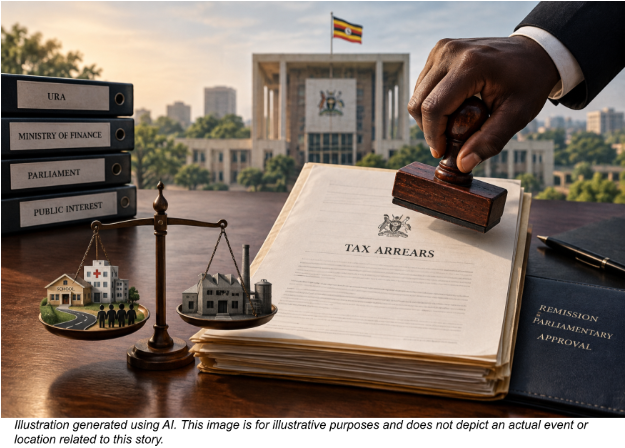
Using Fresh Cuts Uganda Limited’s Shs8.7 billion tax remission as a case study, this explainer examines how tax debts can legally be forgiven, why the decision divided Parliament, and what questions taxpayers should ask when the government gives up revenue.
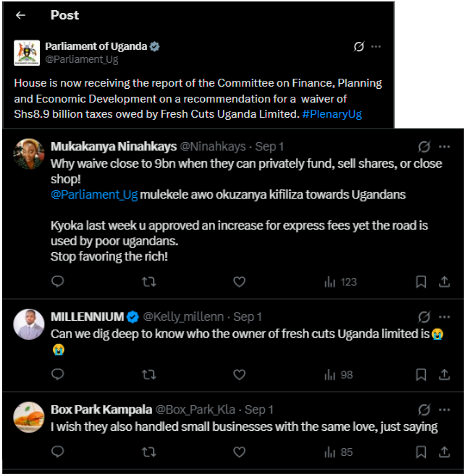
When Parliament approved the remission of billions of shillings in tax arrears owed by Fresh Cuts Uganda Limited, the reaction from many Ugandans was immediate. For example, on X, users questioned why the government would forgive nearly Shs9 billion owed by a private company instead of requiring it to raise capital, sell its assets or close down altogether.
Why should a private company receive such relief while ordinary Ugandans continue to face taxes and fees? Who owns the company? And if Fresh Cuts could not pay its debts, why not simply let it close?
These are legitimate questions. But they also point to a much bigger issue than Fresh Cuts itself.
What happens when the government decides that a tax debt owed by a private company should no longer be collected?
The Fresh Cuts case provides an opportunity to examine how tax remission works in Uganda, who makes such decisions, what evidence is supposed to justify them and, ultimately, who bears the cost when billions in expected government revenue are written off.
This is not an attempt to determine whether Parliament was right or wrong to approve Fresh Cuts’ remission. Instead, it examines what the public record tells us about how such a decision is made and the questions that remain.
The Fresh Cuts case did not begin with the September decision
The public controversy may have erupted after Parliament approved the remission, but the Fresh Cuts case had been moving through Parliament for months.
According to a February 10, 2026 letter from the Ministry of Finance to the Speaker of Parliament, URA had earlier recommended the waiver of Shs8,924,780,601 in tax arrears owed by Fresh Cuts Uganda Limited in a letter dated May 14, 2025.
The Ministry subsequently sought Parliament’s approval for the waiver, and on March 12, 2026, the Minister of State for Finance, Henry Musasizi, formally tabled a request to waive Shs8,924,780,601 in outstanding tax arrears owed by Fresh Cuts Uganda Limited.
“I beg to lay on the Table the waiver of outstanding tax arrears for Fresh Cuts Uganda Limited amounting to Shs8,924,780,601,” Musasizi told Parliament.
The Speaker noted that Section 43(2) of the Tax Procedures Code Act requires the Minister of Finance to seek parliamentary approval before tax can be remitted and referred the matter to Parliament’s Committee on Finance, Planning and Economic Development for scrutiny.
By May, the committee had completed its work. The Fresh Cuts matter was listed on Parliament’s Order Paper as a motion for the adoption of the committee’s report.
The figure eventually approved by Parliament was lower than the amount originally recommended. According to the Ministry of Finance’s February 10, 2026 request to Parliament, URA had recommended the waiver of the full Shs8,924,780,601 in arrears in May 2025. Parliament’s Finance Committee later recommended a waiver of Shs8.73 billion. The records reviewed for this explainer do not clearly explain the basis for the approximately Shs194.8 million difference.
However, the business was not concluded before the end of the 11th Parliament.
In July, the new Parliament formally reinstated the “Report on a recommendation for a waiver of tax arrears for Fresh Cuts Uganda Limited” among unfinished parliamentary business inherited from the previous Parliament.
The case eventually returned to Parliament, where the remission was approved at about Shs8.7 billion.
But before asking whether Fresh Cuts deserved that relief, it is important to understand what Parliament was actually being asked to do.
A tax remission is not the same as giving a company cash
One of the easiest ways to misunderstand the Fresh Cuts decision is to imagine Parliament taking Shs8.7 billion from the Treasury and handing it to the company.
That is not what a tax remission means.
Fresh Cuts Uganda Limited was not being awarded a cash payment of Shs8.7 billion. Instead, Parliament was being asked to approve the government’s decision to give up its claim to collect tax arrears owed by the company.
However, it would also be misleading to suggest that no public money is involved simply because no cash changes hands.
Tax revenue is money the government expects to collect and use to finance public expenditure. When a legally recoverable tax debt is remitted, the government gives up potential revenue.
So the most accurate way to understand a remission is somewhere between two extremes:
Government did not hand Fresh Cuts Shs8.7 billion in cash.
But also:
Government gave up a claim to collect billions of shillings that would otherwise have been part of public revenue.
That is where the question in the headline begins.
If government gives up revenue, who ultimately absorbs the cost?
So, when can government forgive a tax debt?
In plain terms: what does the law actually require?
Section 43 of the Tax Procedures Code Act allows government to write off a tax debt, but only if it can show one of four things is true:
1. Hardship — Paying the debt would genuinely cripple the business, not just make things uncomfortable.
2. Impossibility — There is no realistic way left to collect the money.
3. Undue difficulty — Recovering the debt is technically possible but would be unreasonably hard.
4. Excessive cost of recovery — It would cost the government more to chase the debt than it’s worth collecting.
In short: the law isn’t meant for businesses simply struggling to pay on time. It’s meant for cases where government has genuinely tried to collect and failed — and continuing to try would cost more than it’s worth.
Uganda’s law provides a mechanism for tax remission.
The Fresh Cuts request was specifically presented under Section 43 of the Tax Procedures Code Act, which requires parliamentary involvement in the remission process.
This is important because it means a tax remission is not supposed to be an informal favour granted to a company behind closed doors.
The request moves through a formal process involving government, parliamentary scrutiny and ultimately Parliament.
Even before the request was tabled, Speaker Anita Among raised questions about the basis for granting tax waivers, saying Parliament needed to establish “the criteria of who should be given a waiver and who should not.”
That concern did not disappear.
When several tax-waiver requests were discussed again in July, MPs questioned how taxpayers access remissions and whether the process was transparent.
Minister Musasizi responded that he wanted the system to be transparent enough that even an ordinary businessman with no political connections could understand and access it. The Deputy Speaker also noted that Parliament had been given the final approval role partly to strengthen public scrutiny of such decisions.
That brings us to one of the most important questions in the Fresh Cuts Uganda Limited debate:
What evidence convinced Parliament that this particular debt should no longer be pursued?
Why not simply force Fresh Cuts Uganda Limited to pay?
This is perhaps the strongest public question.
A company owing nearly Shs9 billion does not necessarily have only two options: pay the debt in full or have it forgiven. Depending on its financial position, it may seek new investment, borrow, sell assets, restructure its operations or enter formal insolvency proceedings.
Uganda’s tax law allows remission where the tax cannot be effectively recovered due to hardship, impossibility, undue difficulty or the excessive cost of recovery. The central question, therefore, is not simply whether Fresh Cuts Uganda Limited was struggling financially, but whether there was a realistic and effective way for the government to recover the debt.
So why should the government abandon its claim?
The answer is not as straightforward as either side of the debate might suggest.
According to the arguments presented around the parliamentary process, Fresh Cuts Uganda Limited was described as being in serious financial distress. The majority position considered the company’s financial condition and the difficulty of recovering the outstanding taxes.
But there was disagreement over whether remission was the appropriate response to the company’s financial problems.
The parliamentary debate revealed a central tension: supporters pointed to Fresh Cuts’ financial distress and the difficulty of recovering the debt, while opponents questioned whether a tax waiver was the appropriate solution.
That distinction is crucial.
A company being financially distressed does not automatically mean its debts are unrecoverable.
And this is where the public’s question “Why not sell assets?” becomes legitimate.
If a company still owns valuable land, machinery or other assets, taxpayers are entitled to ask whether those assets were considered before billions in tax arrears were remitted.
The opposing arguments around Fresh Cuts Uganda Limited raised precisely such concerns, including questions about company assets and whether previous recovery arrangements had been fully exhausted.
The public should not have to assume either side was correct.
The evidence behind that decision is exactly what should be open to scrutiny.
But would closing the company solve the problem?
Another common reaction has been simple:
If Fresh Cuts cannot pay, why not let it close?
Whether a financially distressed company should be liquidated or given an opportunity to restructure is not a question with a universally automatic answer.
International insolvency frameworks recognize that decision-makers often have to compare two possible outcomes: the value that could be recovered by selling a company’s assets and the value that could potentially be preserved if the business continues operating.
Uganda’s Insolvency Act provides a legal framework for dealing with companies that cannot meet their obligations, including administration, receivership and liquidation. But insolvency does not mean that one creditor automatically receives all that is owed. Depending on the company’s liabilities and the nature of creditors’ claims, its remaining assets may be subject to competing claims from secured lenders, employees, suppliers, government authorities and other creditors.
The World Bank’s principles on insolvency and creditor rights, for example, recommend assessing distressed businesses on both a going-concern and liquidation basis to determine which route offers the better prospect of recovering value.
Similarly, the United Nations Commission on International Trade Law (UNCITRAL) identifies the need to balance liquidation and reorganization, recognizing that insolvency frameworks must consider creditors, employees and wider public policy concerns, including taxation.
This does not mean that keeping Fresh Cuts alive was necessarily the better option.
It means the public question “Why not simply close it?” requires evidence beyond the fact that the company owed a large tax debt.
To assess whether remission made more sense than liquidation or continued recovery, Parliament would need evidence about the company’s assets, liabilities, creditors, prospects of recovery and the value of the business as an operating enterprise.
And that brings the Fresh Cuts case back to its central accountability question:
What evidence did Parliament rely on to conclude that giving up Shs8.7 billion in tax revenue was preferable to pursuing other recovery options?
Some may conclude that the decision was a case of favoritism. After all, why would Parliament agree to forgive billions owed by one private company while ordinary taxpayers who fail to meet their obligations can face penalties and enforcement?
Is this a case of favoritism?
This is probably the most politically sensitive question, and one that should not be answered through assumption.
There is a difference between a controversial decision and evidence of favoritism or corruption.
The fact that a private company received a tax remission does not, by itself, prove that the decision was politically motivated.
At the same time, transparency is necessary precisely because public suspicion grows when billions are forgiven without citizens clearly understanding why.
The July parliamentary debate itself showed that MPs were already concerned about whether ordinary taxpayers could access the same remission mechanisms as companies with the resources and connections to navigate government institutions.
Minister Musasizi said the process should be transparent enough for a businessman without political connections to access it as well.
That statement points to a bigger accountability question:
Can an ordinary taxpayer realistically access the same legal mechanisms available to a large company?
The answer cannot simply be assumed.
A fair system should have clear criteria that apply consistently.
The public should be able to know:
- who applied for remission;
- how much was owed;
- why remission was requested;
- what recovery efforts had been attempted;
- what evidence demonstrated financial distress;
- and why Parliament concluded that remission was justified.
Without that transparency, even legally valid decisions can struggle to earn public trust.
Who owns Fresh Cuts Uganda Limited and why does that matter?
The question of ownership has also featured prominently in the public debate.
Knowing who owns a company that receives a major public concession is not about assuming wrongdoing.
It is about transparency.
When Parliament agrees to give up billions in tax revenue owed by a private company, citizens have a legitimate interest in understanding who ultimately benefits from that decision.
That includes asking:
- Who are the company’s shareholders?
- Who are its directors?
- Are there any conflicts of interest?
- Did any public official involved in the process have a relationship with the company?
These questions should be answered using official company records, not speculation from social media.
At the time of this explainer, ownership information should therefore be treated as a separate verification exercise requiring documentary confirmation from the relevant company registry.
Not finding evidence of wrongdoing is not proof that no wrongdoing occurred. But neither should the public be asked to stop asking legitimate questions simply because the answers are inconvenient.
Transparency protects both the taxpayer and the company receiving the relief.
Official ownership records for Fresh Cuts Uganda Limited are maintained by the Uganda Registration Services Bureau (URSB) and can be accessed through a paid company search. At the time of publication, this explainer had not independently obtained and verified the company’s official ownership records. We therefore make no claim about who owns Fresh Cuts or whether any of its owners have connections to public officials. The piece will be updated if verified ownership information becomes available.
Why this matters beyond Fresh Cuts
The Fresh Cuts case was among several tax-remission matters inherited by the 12th Parliament from unfinished business of the previous House. On July 14, Parliament reinstated reports involving Fresh Cuts Uganda Limited, Newplan Limited and Innovations for Poverty Action.
Since then, the pattern has become even clearer.
In September, Parliament approved the remission of Shs8.7 billion in tax arrears for Fresh Cuts. A day later, it also approved a Shs18.8 billion tax waiver for Newplan Limited, with MPs citing the company’s financial difficulties and its role in Uganda’s oil and gas sector.
Innovations for Poverty Action has also been the subject of a tax-waiver recommendation, with the parliamentary committee examining the circumstances surrounding its tax arrears and previous arrangements with URA.
This is why understanding the Fresh Cuts case matters.
The question is no longer simply:
Did Fresh Cuts deserve Shs8.7 billion in tax relief?
A broader question is emerging:
What standard should Uganda use when deciding that a tax debt is no longer worth collecting?
That question becomes increasingly important as more remission requests come before Parliament.
Each case may have different circumstances. One company may argue financial distress, another may point to its economic importance, employment or strategic role. But the fundamental questions for Parliament and the public remain largely the same:
- Is the taxpayer genuinely unable to pay?
- What evidence supports that conclusion?
- Has the government attempted reasonable recovery measures?
- Are there assets or other means through which part of the debt could still be recovered?
- Would continued recovery, restructuring or liquidation produce a better outcome?
- What public interest is served by allowing the taxpayer to continue operating?
- What does the government and ultimately the public give up through remission?
- And what safeguards exist to ensure that the process is based on consistent criteria rather than influence?
Fresh Cuts, therefore, is more than a story about one company’s Shs8.7 billion tax debt. It is a case study in a much larger public question: how should a government decide when pursuing a tax debt is no longer in the public interest?
So, who really pays the price?
There is no single taxpayer who receives a bill after a tax debt is remitted.
And viewed against Uganda’s Shs84.3 trillion national budget for the 2026/27 financial year, Shs8.73 billion represents a small fraction of total government spending.
But that does not make the question meaningless.
Government revenue is made up of many individual taxes and debts. When one legally recoverable debt is abandoned, the immediate effect is not that a particular hospital closes or a particular road goes unfunded. Rather, the government has less revenue available than it would have had if the money had been collected.
The significance becomes greater when remission is viewed not as a single isolated decision but as a policy mechanism that can be used repeatedly. Fresh Cuts’ Shs8.73 billion waiver came alongside other tax-remission cases before Parliament, including Newplan Limited and Innovations for Poverty Action.
That is where the question of who pays becomes more concrete.
The public does not necessarily pay for one remission through a direct new tax. It pays through the opportunity cost of revenue that the government has chosen not to collect and through the cumulative effect if similar debts are repeatedly written off.
Fresh Cuts is not the final question
The public reaction to the Fresh Cuts decision may have been driven by anger, but beneath that anger are reasonable questions about fairness.
Why should one taxpayer be forgiven while another is pursued?
When does financial hardship become sufficient grounds to abandon a tax debt?
What happens when a company’s failure is caused by poor management rather than forces beyond its control?
And how can citizens know that a remission was based on evidence rather than influence?
The Fresh Cuts case does not require Ugandans to choose between blindly trusting Parliament and assuming corruption.
There is a third option:
Demand the evidence.
Uganda’s tax remission mechanism exists in law. Parliament has a role in approving such decisions. But legality alone does not remove the need for transparency.
When billions in public revenue are potentially written off, citizens have a right to understand how the decision was reached, what alternatives were considered and what evidence persuaded their representatives.
That may be the most important lesson from the Fresh Cuts controversy.
The next time Parliament is asked to forgive a company’s tax debt, the public should not have to begin with outrage or speculation.
They should already know the questions to ask.
Why we wrote this
This explainer was prompted by the public debate surrounding the remission of tax arrears owed by Fresh Cuts Uganda Limited. Our aim is not to declare Parliament right or wrong, or to determine whether Fresh Cuts deserved the remission.
We wanted to make a government mechanism that is often discussed through headlines and political arguments easier for the public to understand.
Fresh Cuts is used here as a case study to examine how tax remission works, why such decisions can be controversial and what information citizens should expect before the government gives up billions in potential tax revenue.
The goal is simple: the next time a tax waiver is proposed, readers should be able to interrogate the decision using evidence rather than simply reacting to the figure.
Sources and methodology
This explainer was based primarily on official parliamentary and government records relating to the Fresh Cuts Uganda Limited tax remission.
Key sources include:
- Parliament of Uganda Hansard and Order Papers covering the Fresh Cuts remission process;
- the Ministry of Finance’s original request for parliamentary approval to waive Fresh Cuts’ tax arrears;
- Parliament’s Committee on Finance, Planning and Economic Development reports and parliamentary proceedings;
- the Tax Procedures Code Act, particularly Section 43 on remission of tax;
- Uganda’s insolvency framework;
- the World Bank’s Principles for Effective Insolvency and Creditor/Debtor Regimes;
- UNCITRAL’s Legislative Guide on Insolvency Law; and
- official parliamentary records relating to other recent tax-remission cases
Social media posts referenced in the introduction were used to illustrate public questions surrounding the decision and were not treated as evidence of wrongdoing.
Where the public record did not provide a clear answer, this explainer identifies the gap rather than drawing conclusions from speculation.