

FALSE: Cancer does not account for six out of every 10 deaths in Uganda

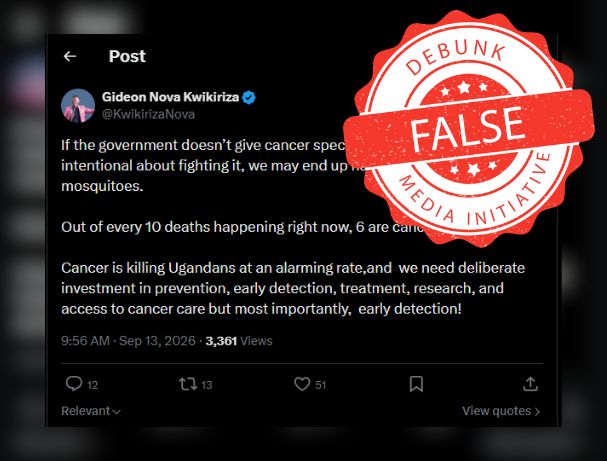
CLAIM
A post published on X by Gideon Nova Kwikiriza (@KwikirizaNova) on September 13, 2026, claimed that “out of every 10 deaths happening right now, 6 are cancer-related.”
The claim was made while calling for the government to give cancer more attention and increase investment in prevention, early detection, treatment, research and access to cancer care.
BACKGROUND:
Uganda is facing a growing burden of cancer, with health authorities reporting an increase in the number of people seeking cancer care. Daily Monitor reported that the Uganda Cancer Institute (UCI) registered 8,764 new cancer patients in 2025, up from 7,945 in 2024, representing a 10 percent increase. The institute also recorded about 67,000 patient visits during the year.
The increase in cases has coincided with concerns about late diagnosis. New Vision reported that 60–70 percent of cancer patients at UCI arrive with advanced-stage disease, classified as stage three or four. The report quoted the Director General of Health Services, Charles Olaro, as saying that late presentation makes treatment more difficult.
The growing demand for cancer services and concerns about late diagnosis have renewed calls for greater attention to cancer prevention, early detection and treatment. It is against this backdrop that an X post published on September 13, 2026, claimed that six out of every 10 deaths happening in Uganda are cancer-related.
FINDINGS
The claim states that six out of every 10 deaths in Uganda are cancer-related, which would mean that cancer accounts for approximately 60% of all deaths.
Available evidence does not support this figure.
National Share of Total Mortality in Uganda
| Broad cause of death category | Share of total deaths | Key specific drivers in Uganda | Context for the fact check |
|---|---|---|---|
| Communicable, maternal, perinatal and nutritional conditions | 50.8% | Malaria, HIV/AIDS, lower respiratory infections, tuberculosis, neonatal and maternal conditions. | More than half of estimated deaths fall within this broad category. |
| Noncommunicable diseases (NCDs) | 36.9% | Cardiovascular diseases, cancers, diabetes and chronic respiratory diseases. | Cancer is one component of this category; therefore, cancer cannot account for 60% of all deaths if all NCDs combined account for 36.9%. |
| Injuries | 10.8% | Road traffic injuries, interpersonal violence, falls, drowning and other injuries. | Injuries form a separate broad category of mortality. The 10.8% figure should not be interpreted as accidents alone. |
| Other pandemic-related outcomes | 1.5% | COVID-19 pandemic-related outcomes. | A separate category in the WHO estimates. |
| TOTAL | 100% | — | The broad categories together account for the full estimated mortality distribution. |
Source: World Health Organization (WHO), 2021 cause-of-death estimates for Uganda.
Note: The figures represent broad categories of mortality; cancer is a component of the NCD category, while injuries include road traffic injuries and other forms of injury.
The figures also provide important context for the claim. WHO’s 2021 estimates place all noncommunicable diseases combined at 36.9 percent of deaths in Uganda. Cancer is only one component of this broader category. This means the claim that cancer accounts for 60 percent of all deaths is inconsistent with the WHO mortality distribution.
A 2024 population-based study conducted by researchers from the Uganda Cancer Institute and the Gulu Cancer Registry examined cancer incidence and mortality across 10 sub-regions of Uganda. The researchers noted that non-communicable diseases account for about 33% of mortality in Uganda, while cancers contribute about one-third of these deaths, equivalent to approximately 9% of all deaths.
The researchers also acknowledged limitations in Uganda’s cancer surveillance system. At the time of the study, the Kampala and Gulu population-based cancer registries covered only about 11.9% of Uganda’s population, making it difficult to obtain a complete picture of the country’s cancer burden.
To address this gap, the researchers examined cancer data from 55 districts across 10 sub-regions, covering a catchment population of approximately 18.1 million people, or 43% of Uganda’s population. The data covered the period from 2017 to 2020.
The World Health Organization’s country-level cause-of-death estimates provide further context. In 2021, all non-communicable diseases combined accounted for 36.9% of deaths in Uganda. This category includes cancer, cardiovascular diseases, diabetes, chronic respiratory diseases and other non-communicable conditions. Communicable, maternal, perinatal and nutritional conditions accounted for 50.8%, while injuries accounted for 10.8%.
Because cancer is only one component of the 36.9% classified as non-communicable diseases, the WHO figures cannot support the claim that cancer alone accounts for 60% of all deaths.
WHO’s 2021 estimates also identify malaria, HIV/AIDS, lower respiratory infections, preterm birth complications and tuberculosis among the leading causes of death in Uganda. Cancer does not appear among the overall top 10 causes of death in those estimates.
The WHO estimates specifically list cervical cancer among the leading causes of death for women, with an estimated mortality rate of 19.3 deaths per 100,000 women in 2021. However, this does not indicate that cancer as a whole accounts for the majority of deaths in Uganda.
More recent estimates from the International Agency for Research on Cancer (IARC) also demonstrate the scale of Uganda’s cancer burden. GLOBOCAN estimated 35,968 new cancer cases and 24,629 cancer deaths in Uganda in 2022.
However, the figure of 24,629 cancer deaths is an estimate of the number of deaths attributed to cancer. It is not a percentage of all deaths. Determining whether cancer accounts for 60% of deaths would require a comparable estimate of deaths from all causes for the same population and period.
There is also more recent national data from the Uganda Bureau of Statistics (UBOS). Its Uganda Vital Statistics Report 2024 recorded 46,543 deaths reported from health facilities in 2024, of which 17,453 were medically certified. Among the medically certified registered health-facility deaths, 265 were attributed to malignant neoplasms. These figures cover deaths reported through health facilities and therefore should not be interpreted as representing all deaths occurring in Uganda.
What about “happening right now”?
The wording “happening right now” presents an additional problem.
Uganda does not have complete, reliable real-time national cause-of-death registration. The UCI-linked study notes the limitations of death-registration systems in the region and the resulting challenges in accurately determining causes of death at the population level.
This means there is no reliable real-time national dataset that can establish that six out of every 10 people currently dying in Uganda are dying from cancer.
Debunk Media Initiative contacted the Uganda Cancer Institute seeking expert clarification on whether any more recent credible evidence supports the 60% figure and how the available cancer mortality estimates should be interpreted. At the time of writing, we are awaiting a response from the Institute.
Uganda’s cancer burden is clearly substantial, as demonstrated by the estimated 24,629 cancer deaths in 2022 and the rising number of people seeking cancer care. But the evidence reviewed does not support the specific claim that 60% of all deaths in Uganda are cancer-related.
METHODOLOGY
To verify the claim, Debunk Media Initiative reviewed available national and international data on causes of death and cancer mortality in Uganda, with particular attention to whether any credible source supports the assertion that cancer accounts for six out of every 10 deaths.
We first examined the World Health Organization’s country-level cause-of-death estimates for Uganda, focusing on the broad distribution of deaths by cause in 2021. These estimates were used to establish the proportion attributed to noncommunicable diseases, communicable and related conditions, injuries, and other pandemic-related outcomes.
We then reviewed a 2024 population-based study published in ecancer, conducted by researchers from the Uganda Cancer Institute and the Gulu Cancer Registry. The study was examined for its estimates of Uganda’s cancer burden, the population covered by its cancer surveillance, and the limitations the researchers identified in estimating national cancer mortality.
To assess more recent cancer mortality estimates, we reviewed the International Agency for Research on Cancer (IARC) GLOBOCAN 2022 Uganda fact sheet, comparing its estimated number of cancer deaths with the claim being made in the X post. We also reviewed the Uganda Bureau of Statistics (UBOS) Uganda Vital Statistics Report 2024 to examine the latest available registered health-facility mortality data and the causes recorded among medically certified deaths.
Because the claim specifically refers to deaths “happening right now,” we also considered whether Uganda has sufficiently complete and current national cause-of-death data to support a real-time estimate of cancer’s share of mortality.
Finally, Debunk Media Initiative contacted the Uganda Cancer Institute for expert clarification on whether any more recent credible evidence supports the 60 percent figure and to obtain guidance on interpreting the available cancer mortality estimates. At the time of writing, a response was still pending.
The assessment therefore compared the claim against multiple datasets from different periods and methodologies, while taking into account the limitations of Uganda’s mortality and cancer-registration systems.
VERDICT: FALSE
The claim that six out of every 10 deaths in Uganda are cancer-related is false.
WHO’s 2021 estimates show that all noncommunicable diseases combined accounted for 36.9% of deaths in Uganda, with cancer being only one part of that category. WHO also identifies several infectious and other conditions among the country’s leading causes of death. While cancer causes thousands of deaths in Uganda each year, the available evidence does not support the claim that it accounts for 60% of all deaths.