

FALSE: No credible evidence links Olara Otunnu to atrocities, while records show he has repeatedly spoken out against human rights abuses

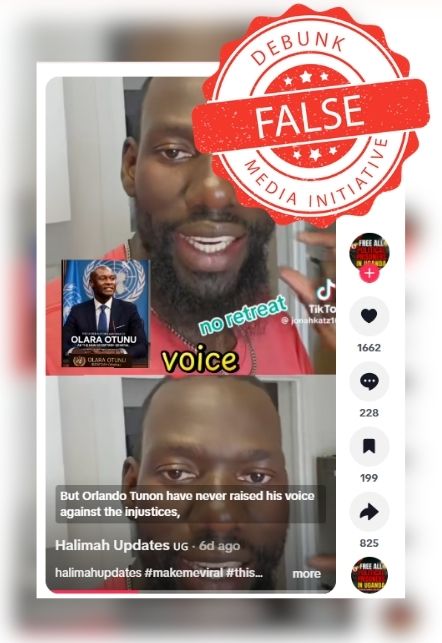
CLAIM: A viral TikTok video claims that Ugandan diplomat and former UN Under-Secretary-General Olara Otunnu was involved in numerous atrocities, human rights abuses and injustices in Uganda and neighbouring countries. The video further alleges that Otunnu has never raised his voice against the atrocities, killings and human rights abuses committed in Uganda and the region.
Findings
The claim in the TikTok video is also presented without identifying any specific atrocity, incident, location, victim, investigation or finding that links Otunnu personally to such abuses.
A review of available UN records, reputable news reports and human rights documentation found no credible evidence supporting the allegation that Olara Otunnu was personally involved in “numerous atrocities, human rights abuses and injustices” in Uganda or neighbouring countries or that he is being implicated, investigated or held responsible for atrocities or human rights abuses as alleged in the video.
Instead, available records largely document Otunnu’s career as a diplomat and advocate on issues relating to armed conflict and human rights.
Otunnu served as the UN Secretary-General’s Special Representative for Children and Armed Conflict from 1997 to 2005. During that period, his mandate involved advocating for the protection of children affected by war and promoting accountability for grave violations against children.
OTUNNU DID SPEAK OUT ABOUT ABUSES IN UGANDA
The video’s claim that Otunnu “never raised his voice” against atrocities and human rights abuses in Uganda is contradicted by multiple documented statements.
He condemned attacks on civilians and children in Uganda
In June 1998, Otunnu publicly condemned the attack on Kichwamba Technical College in western Uganda, where dozens of students were killed.
In June 1998, ADF rebels attacked Kichwamba Technical College in western Uganda, killing an estimated 50 to 80 students and abducting others, according to Human Rights Watch. As the UN Secretary-General’s Special Representative for Children and Armed Conflict, Otunnu expressed shock and outrage and described the attack as a horrific act. He also condemned the continuing abuse of children in Uganda’s conflict zones, including abduction, maiming, displacement and deprivation of education and medical care.
This directly contradicts the claim that he remained silent while atrocities and abuses were taking place.
He took concerns about Northern Uganda to the UN human rights body
Otunnu’s criticism was not limited to isolated attacks.
In a statement to the UN Commission on Human Rights concerning Northern Uganda, Otunnu described the situation as a “human rights and humanitarian catastrophe.”
He drew the attention of the international human rights community to the prolonged conflict and spoke about the suffering of civilians caught in the violence.
His statements were significant enough for the Ugandan government to formally respond through a communication to the UN Security Council. In the response, the government explicitly rejected Otunnu’s presentation and described allegations he had made concerning the situation in Northern Uganda as unfounded.
Regardless of whether one agrees with Otunnu’s assessment or the government’s response, the official exchange provides clear documentary evidence that Otunnu had publicly raised allegations concerning human rights abuses in Uganda before an international human rights forum.
He continued raising questions about atrocities and killings after leaving the UN
Otunnu also publicly raised concerns about alleged atrocities and unexplained deaths in Uganda after returning to domestic politics.
In 2013, while serving as president of the Uganda People’s Congress (UPC), Otunnu reportedly called for investigations into disappearances and mysterious deaths that had occurred during different periods of Uganda’s political history.
According to Daily Monitor, the incidents he referenced included atrocities committed during the Luweero conflict, massacres, counter-insurgency operations in Northern and Eastern Uganda, and the killing of unarmed demonstrators.
His remarks eventually resulted in a defamation case involving President Yoweri Museveni. In 2017, Buganda Road Court dismissed the case after the prosecution failed to produce sufficient evidence.
This provides another documented instance of Otunnu publicly speaking about alleged atrocities, killings and abuses in Uganda.
WHAT ABOUT NEIGHBOURING COUNTRIES?
OTUNNU’S ADVOCACY EXTENDED BEYOND UGANDA
The TikTok video also broadly suggests that Otunnu remained silent about atrocities and human rights abuses occurring in neighbouring countries.
However, Otunnu’s role as the UN Secretary-General’s Special Representative for Children and Armed Conflict involved advocacy for children affected by conflict internationally. During his tenure, he undertook missions to several conflict-affected countries, including Rwanda, Burundi, Sudan, Mozambique, Colombia and Sierra Leone.
His engagement in the region is also documented during a 1999 tour of Rwanda, Burundi and Sudan, where he raised concerns about the protection and welfare of children affected by armed conflict and secured commitments from parties involved in the conflicts.
Otunnu also publicly called on governments and armed groups to stop attacks on civilians and comply with international humanitarian and human rights standards. In a 1998 UN press briefing, he repeatedly called on all parties to armed conflicts to cease attacks against civilians and end the recruitment and use of child soldiers.
Therefore, the available record does not support the suggestion that Otunnu had remained silent in the face of atrocities and human rights abuses beyond Uganda.
Methodology
To verify the claim, we reviewed the TikTok video’s allegations and examined whether credible evidence exists linking Olara Otunnu to atrocities, human rights abuses or related violations in Uganda and neighbouring countries.
We searched available UN records, including documents from the Office of the Special Representative of the Secretary-General for Children and Armed Conflict, as well as reputable news reports and human rights documentation for evidence of Otunnu being accused, implicated, investigated or held responsible for atrocities or human rights abuses.
We also reviewed Otunnu’s public record to establish whether he had previously spoken out against atrocities, killings and human rights abuses. This included examining his statements on attacks against civilians and children in Uganda, his presentation to the UN Commission on Human Rights on the conflict in Northern Uganda, his later public calls for investigations into alleged atrocities and unexplained deaths in Uganda, and his advocacy in conflict-affected countries within the region.
OUR VERDICT. False
Therefore, the claim that Olara Otunnu was involved in numerous atrocities and human rights abuses and that he has remained silent about abuses in Uganda and neighbouring countries is FALSE.