

False: There is no evidence that Childhood Immunisation Campaigns In Uganda Is A Foreign Plot To Harm Children Or Make Them Poor


Claim
A TikTok video posted by Katendenock circulating in Uganda claims that upcoming childhood immunisation campaigns are orchestrated by a “secret government” or “New World Order” to harm African children.
Based on these allegations, the speaker urges parents not to take children aged between two and 14 years for immunisation.
The video garnered 13.7K likes, 355 comments, 2008 saves and 45.2K shares. In the video, Katende claims the exercise is “poisonous” and will be conducted through the distribution of tablets, mosquito nets, during school programs with the intention of infecting children with a so-called “poverty disease.”
The video also claims that mosquito nets distributed through public health programmes contain substances that weaken children’s genes and further suggests that similar methods were used in the past to spread HIV/AIDS among Africans.
Because the video discourages routine childhood vaccination using several unsupported conspiracy theories, we reviewed the claims against available scientific evidence and official public health information.
Background
Across Africa, governments routinely conduct child health and immunization campaigns targeting diseases such as measles, polio, and HPV. These programs are often implemented in partnership with global health organizations like the World Health Organization, UNICEF as reported here, here and here for Uganda.
In Uganda, for example, school-based and community outreach programs may include: routine vaccinations, Deworming tablet distribution, Mosquito net distribution for malaria prevention.
These initiatives are publicly announced and are part of broader disease prevention strategies as reported here and here.
Evidence
A review of Uganda’s immunisation programme, official public health information and scientific evidence found no credible evidence supporting the claim that the country’s childhood immunisation campaign is harmful or controlled by a foreign secret government.
Instead, the allegations presented in the video combine several long-debunked conspiracy theories about vaccines, HIV, mosquito nets and international health organisations.
Uganda’s immunisation programme is managed by the Ministry of Health
Our investigation using the Debunk Info Verifier tool found no credible evidence supporting the existence of a “secret government” controlling immunisation efforts in Africa. The tool notes that while conspiracy theories have circulated claiming that vaccination programmes are part of a secret agenda to control or reduce African populations, these claims remain unverified. It also highlights studies showing that such narratives have contributed to vaccine scepticism and public distrust in some African countries. Overall, the tool concludes that there is no verified evidence of any clandestine entity overseeing immunisation efforts in Africa.
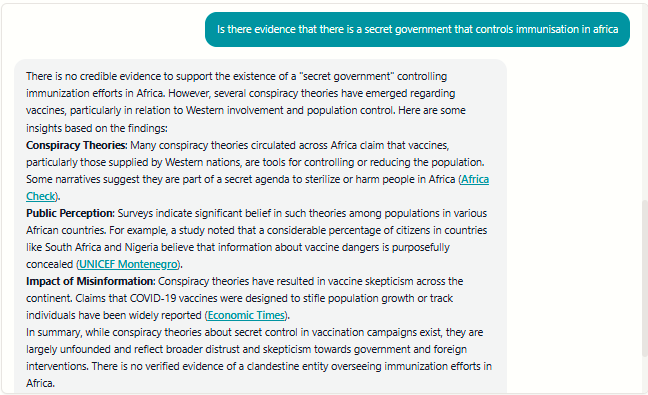
The central allegation in the video is that a secret foreign government controls Uganda’s immunisation campaign.
However, available evidence shows that childhood immunisation in Uganda is coordinated by the Ministry of Health through the Uganda National Expanded Programme on Immunization (UNEPI).
The Ministry develops immunisation policies, coordinates vaccination campaigns and oversees implementation through Uganda’s public health system.
International organisations including the World Health Organization (WHO), UNICEF and Gavi, the Vaccine Alliance support Uganda by providing technical expertise, vaccine procurement, cold-chain equipment, health worker training and financial assistance.
Vaccination policies are also informed by scientific recommendations from the National Immunisation Technical Advisory Group (NITAG), which provides independent, evidence-based advice to the Ministry of Health.
These organisations support Uganda’s immunisation programme but do not secretly control the country’s public health policies or direct vaccination campaigns on behalf of a foreign government.
We found no evidence that England, the “New World Order” or any alleged secret government directs Uganda’s childhood immunisation programme.
The allegations used to support the conspiracy are not backed by evidence
To convince viewers that the immunisation campaign is harmful, the speaker makes several additional claims.
One of them is that vaccines introduced HIV into African populations and continue to spread or worsen the disease.
However, available scientific evidence contradicts this claim.
Research reviewed during this fact check shows that HIV is transmitted through contact with infected body fluids, including blood, semen, vaginal fluids and breast milk. It is also transmitted from mother to child during pregnancy, childbirth or breastfeeding. Scientific studies have consistently found no evidence that routine childhood vaccines transmit HIV or were used to introduce the virus into African populations.
The speaker also claims that mosquito nets distributed through public health programmes contain chemicals that weaken the genes of African children.
Evidence reviewed from the World Health Organization shows that insecticide-treated mosquito nets are treated with low-dose pyrethroid insecticides designed to kill or repel malaria-carrying mosquitoes. These insecticides have undergone extensive safety assessments and are approved for public health use.
Although some users may experience mild, temporary skin or eye irritation when using a newly opened net, there is no scientific evidence that sleeping under treated mosquito nets alters human DNA, weakens genes or causes infertility.
The video further alleges that vaccination campaigns are intended to make Africans poor.
However, no evidence is presented to support this assertion.
Vaccination programmes are public health interventions designed to prevent infectious diseases that can cause illness, disability and death, while improving health and saving lives. Rather than increasing poverty, they are intended to improve public health by preventing disease, reducing healthcare costs and protecting communities from vaccine-preventable illnesses.
We found no credible evidence supporting the claim that childhood immunisation campaigns are intended to make Africans poor.
Available evidence shows routine immunisation benefits public health
Rather than harming children, routine childhood immunisation is intended to protect them against vaccine-preventable diseases.
Uganda’s immunisation programme provides vaccines that protect children against diseases including tuberculosis, polio, hepatitis B, diphtheria, pertussis (whooping cough), tetanus, pneumococcal disease, rotavirus diarrhoea, measles, rubella, yellow fever and malaria.
Uganda has been certified free of wild poliovirus since 2010, and routine immunisation has contributed to reducing vaccine-preventable diseases such as measles, neonatal tetanus, diphtheria and whooping cough. Maintaining high vaccination coverage remains important in preventing outbreaks of these diseases.
The Ministry of Health continues to strengthen routine immunisation through initiatives such as malaria vaccine introduction, outreach campaigns targeting children who missed routine vaccinations and improvements in vaccine storage and distribution.
Public health experts warn that misinformation discouraging parents from vaccinating their children can reduce immunisation coverage and increase the risk of outbreaks of preventable diseases.
Methodology
To verify the claim, Debunk Media Initiative applied a multi-step verification process.
We analysed the claims made in the TikTok video, searched the Debunk Info Verifier tool, reviewed official information published by Uganda’s Ministry of Health, WHO, UNICEF, Gavi and other public health institutions, and examined scientific literature on vaccine safety, HIV transmission and insecticide-treated mosquito nets.
We also compared the video’s allegations with available public health records and official guidance before reaching our conclusion.
Verdict: False
Childhood immunisation campaigns in Uganda are not a foreign plot to harm children or make them poor. The claim is a baseless conspiracy theory with no factual support. Such misinformation can discourage participation in legitimate public health programs and put lives at risk. The public is advised to disregard the claim and rely on credible health information from trusted sources.