

MISLEADING: The article takes a genuine regional food-security emergency in Karamoja and presents it as a broader national crisis.

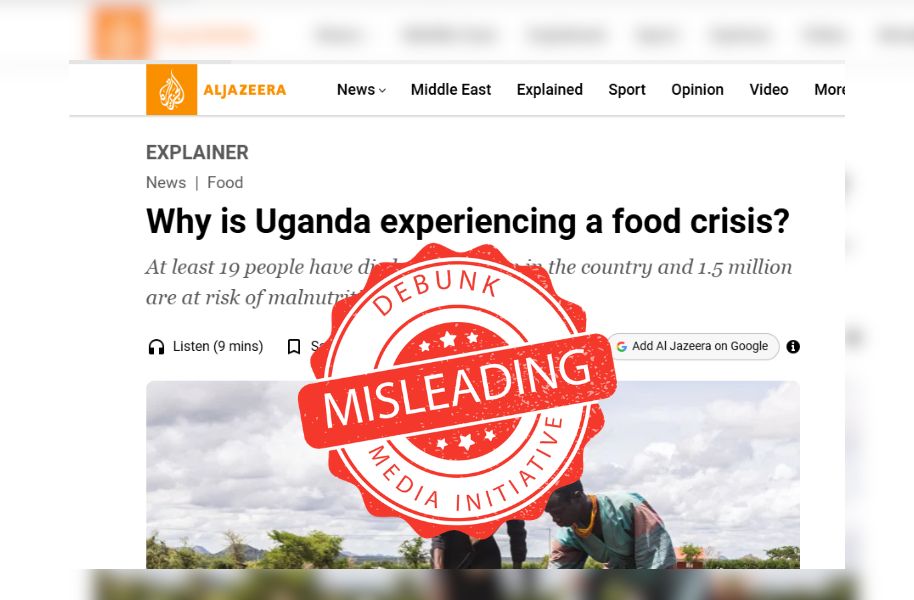
CLAIM:
“Why is Uganda experiencing a food crisis?”
The claim appeared in an Al Jazeera explainer published on July 29, 2026, under the headline “Why is Uganda experiencing a food crisis?” The article says a hunger crisis is brewing in Uganda and attributes the worsening situation to drought, crop failures and other factors. It identifies the Karamoja region in northeastern Uganda as the worst-hit area.
BACKGROUND
Uganda is facing a serious food-security problem, but our investigation found that the severity of the situation varies considerably across the country.
The most severe conditions are in Karamoja, a dry region in northeastern Uganda where many communities depend on crop farming and livestock. Al Jazeera reports that at least 19 people had died of starvation in Karamoja and that the government had begun distributing emergency food relief in the region. The article also says crop losses in most affected areas had reached between 50 and 70 percent.
The situation has also been acknowledged by the Ugandan government. On July 21, the Office of the Prime Minister flagged off more than 9.4 million kilograms of maize flour and beans for distribution to 313,987 households in 480 parishes across Karamoja. The government said the relief was intended for families affected by the prolonged dry spell in the sub-region.
The Uganda People’s Defence Forces also reported that the emergency food distribution was being rolled out across all nine districts of Karamoja, following the prolonged dry spell. This shows that the government itself was responding to a serious food emergency, but the response was specifically focused on the Karamoja sub-region.
The Guardian, reporting on the situation two days before Al Jazeera, similarly described a crisis building in the Karamoja region and reported that at least 19 people had died from hunger.
FINDINGS:
We first looked at the latest food-security assessment from FEWS NET, which covers Uganda from June 2026 to January 2027.
The assessment confirms that Uganda is facing widespread food-security challenges. FEWS NET projects that 2.5–2.99 million people will need food assistance between June 2026 and January 2027. However, this figure includes people experiencing Stressed (IPC Phase 2) and worse outcomes, so it should not be interpreted as meaning that all 2.5–2.99 million people are in Crisis-level food insecurity.
When we looked at the geographical breakdown, the picture became clearer. Food insecurity is not limited to Karamoja. FEWS NET’s assessment shows that several parts of Uganda are experiencing Stressed (IPC Phase 2) conditions, while the central region is classified as Minimal (IPC Phase 1). Crisis-level conditions (IPC Phase 3), however, are concentrated in Karamoja and some refugee-hosting areas.
FEWS NET projects Crisis (IPC Phase 3) outcomes across Karamoja from June 2026 through January 2027. It also projects Crisis-level outcomes in northern refugee settlements, while southern refugee settlements are expected to deteriorate from Stressed to Crisis later in the projection period.
The situation is different in much of the rest of Uganda. FEWS NET says northern, eastern and western regions are currently in Stressed (IPC Phase 2), while the central region is in Minimal (IPC Phase 1). It also expects most bimodal areas to maintain Stressed conditions through January, with near-average first-season harvests supporting food availability.
We then looked at the latest Integrated Food Security Phase Classification (IPC) assessment for Karamoja. It found that approximately 473,000 people, or 32 percent of the analyzed population, were facing IPC Phase 3 or worse between April and July 2026. Of these, about 432,000 were in Crisis (Phase 3) and 41,000 were in Emergency (Phase 4). All nine districts in Karamoja were classified in Crisis.
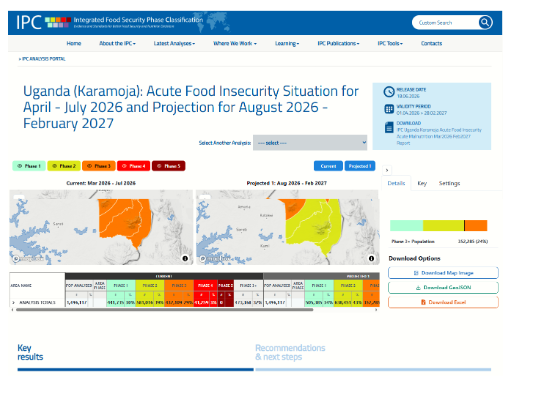
The same IPC assessment projects some seasonal improvement between August 2026 and February 2027, with the number of people in Phase 3 or worse expected to fall to about 352,000. However, food insecurity is expected to remain persistent in several Karamoja districts.
We also checked the crop-loss figures used in Al Jazeera’s report. FEWS NET reports that poor rainfall in Karamoja has caused crop losses of 50–70 percent in most areas. However, the same assessment says most bimodal areas of Uganda are expected to have near-average first-season harvests, with tubers and perennial crops helping to offset some of the losses caused by poor rainfall.
This distinction is important. The evidence does not show that Uganda is free from food insecurity outside Karamoja. Rather, it shows that the severity varies from one part of the country to another. Crisis-level conditions are concentrated in particular areas, while other regions are classified as Stressed or Minimal.
The article’s own reporting largely concentrates on Karamoja, but its headline and framing generalize the situation to Uganda as a whole. The reported deaths, severe crop losses and the government’s emergency food distribution described in the article are largely centered on the sub-region. When we compared this with the latest FEWS NET and IPC assessments, we found that food insecurity does extend beyond Karamoja, but the severity varies considerably across Uganda. Crisis-level conditions are concentrated in Karamoja and some refugee-hosting areas, while several other regions are classified as Stressed and the central region as Minimal.
METHODOLOGY:
To investigate the claim, we first reviewed Al Jazeera’s July 29 article and examined how it described the geographical scope of the food crisis.
We then compared that description with the latest available food-security assessments from FEWS NET and the Integrated Food Security Phase Classification (IPC). We looked at the IPC classifications assigned to different parts of Uganda, the number of people affected and the projected food-security situation through January 2027.
We also reviewed reports from Uganda’s Office of the Prime Minister and the Uganda People’s Defence Forces to establish where the government’s emergency food-relief operation was being implemented.
Finally, we compared the findings with independent reporting by The Guardian to determine whether the severe conditions described by Al Jazeera were being reported as a nationwide crisis or as a crisis concentrated in particular parts of Uganda.
Our investigation focused on the geographical scope and severity of the food-security situation, rather than disputing whether Uganda is experiencing food insecurity.
VERDICT: Misleading.
The article presents a genuine food-security emergency in Karamoja as a broader food crisis affecting Uganda, while the latest evidence shows that Crisis-level conditions are concentrated in Karamoja and some refugee-hosting areas.