

Misleading Headline: The Evidence Does Not Support The 0.01% Ownership Claim

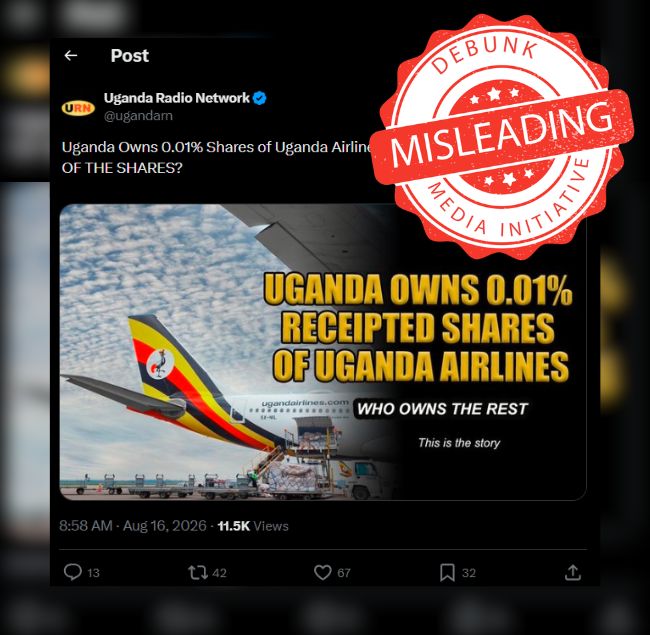
CLAIM:
An X post by Uganda Radio Network (URN) claims that Uganda owns 0.01% of the shares in Uganda Airlines and asks, “Who owns the rest of the shares?” The claim is based on the Auditor General‘s finding that Government had invested about UGX1.984 trillion in the airline, while only UGX200 million was recognized as share capital.
What Uganda Radio Network said:
According to URN’s YouTube analysis, the UGX200 million issued share capital is compared with the approximately UGX1.984 trillion that the Government has invested in Uganda Airlines. This comparison is used to arrive at the 0.01% figure and raises the question of who owns the remainder of the airline. The underlying figures are indeed contained in the Auditor General’s reporting.
However, while URN correctly cites these figures, the analysis does not demonstrate how the comparison establishes that Uganda owns only 0.01% of Uganda Airlines. The 0.01% ownership claim is prominently presented in the video’s thumbnail, but the video does not clearly establish the basis for treating the difference between the two financial figures as the shares owned by other parties.
The headline itself:
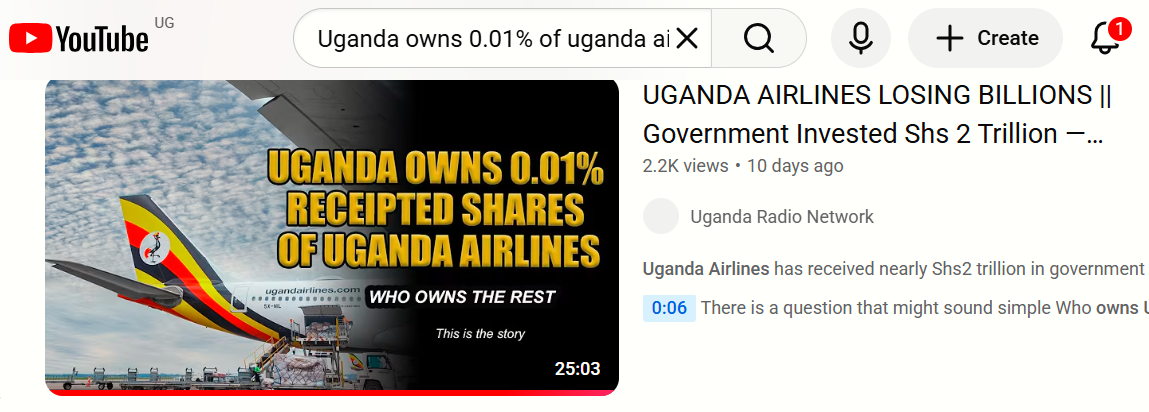
The thumbnail and title accompanying URN’s video read: “UGANDA OWNS 0.01% RECEIPTED SHARES OF UGANDA AIRLINES — WHO OWNS THE REST — This is the story.” Read closely, this is not a neutral summary of an accounting discrepancy. It is three separate claims stacked together, and each one goes further than the underlying evidence supports:
- “Uganda owns 0.01%” — stated as settled fact, with no hedge such as “only formally recorded as” or “reportedly.” It reads as an ownership finding, when it is in fact a ratio of two different accounting categories.
- “Who owns the rest” — this is the most consequential line in the headline. It does not ask why most of Government’s investment has not been formally converted to share capital; it implies an unknown third party holds the missing 99.99%. Nothing in the Auditor General’s report suggests this, and parliamentary records from 2019 and 2025 both confirm the two Government ministries as the sole shareholders.
- “This is the story” — teaser copy designed to draw a click or a watch on the promise of revealing a hidden owner. The actual audit finding is a routine, if concerning, capitalization and accounting delay, not a mystery about who secretly controls the airline.
In other words, the headline does not merely omit context, it actively asserts a claim (an unresolved ownership question) that the source material it is drawn from does not make.
What we found:
Our review of parliamentary records and reports shows that the issue of Uganda Airlines’ ownership and shareholding has previously been discussed and clarified in Parliament.
In March 2019, Parliament examined documents concerning the airline’s shareholding after questions arose over its ownership. The documents presented to Parliament showed 2 million shares worth UGX200 million, with one million shares allocated to the Ministry of Finance and one million to the Ministry of Works and Transport. The then Finance Minister Matia Kasaija also told the committee that the Government owned the shares, while the remaining shares were intended for future allotment pending capitalization.
More recent parliamentary scrutiny has continued to treat Government investment and the airline’s shareholding as separate issues. In September 2025, Parliament discussed the Government’s investment in the airline, its accumulated losses and its need for additional Government funding.
The Auditor General’s earlier audit reports also illustrate this distinction. In the 2020 audit, for example, the OAG reported UGX200 million in share capital alongside UGX934.84 billion in share application funds, while noting that the Government had invested UGX935.04 billion. The report treated these as separate components of the company’s equity funds rather than calculating Government’s ownership as the ratio between the two amounts.
A recycled claim:
This is not the first time questions about Uganda Airlines’ ownership have emerged from its shareholding records. In March 2019, parliamentary documents created controversy after they appeared to show that the Government held only 0.01% of the airline, with shares instead appearing in the individual names of then Finance Minister Matia Kasaija and Works and Transport Minister Monica Azuba. Parliament subsequently questioned the arrangement, and Government presented corrected share-allotment documents showing the shares were held through the two ministries.
The current controversy bears a striking resemblance: a small figure recorded as share capital is being compared with a much larger amount of Government investment and presented as an indication of Government’s ownership percentage. The Auditor General’s finding, however, records the remaining funds as “Share Application Funds and GoU Capitalization, pending formal conversion,” rather than identifying another shareholder.
The question:
This raises a key question about URN’s conclusion: Did the analysis establish a factual finding that Uganda owns only 0.01% of Uganda Airlines, or did the headline derive that figure by comparing two different financial measures?
The Auditor General’s report establishes the amounts involved, but the report does not itself state that Uganda owns 0.01% of the airline. The 0.01% figure is obtained by comparing issued share capital with total Government investment. That calculation may highlight a genuine issue concerning the formalization and accounting of Government’s investment, but it does not, on its own, establish who owns the remaining 99.99%.
Verdict
MISLEADING. URN correctly cites the figures from the Auditor General’s report. However, its analysis does not show how those figures lead to the conclusion that Uganda owns only 0.01% of Uganda Airlines. The evidence shows the amount invested by Government and the share capital recognized, but it does not establish an ownership percentage of 0.01%.