

FALSE: Facebook Post Falsely Implies That Janet Museveni Is Dead

Claim:
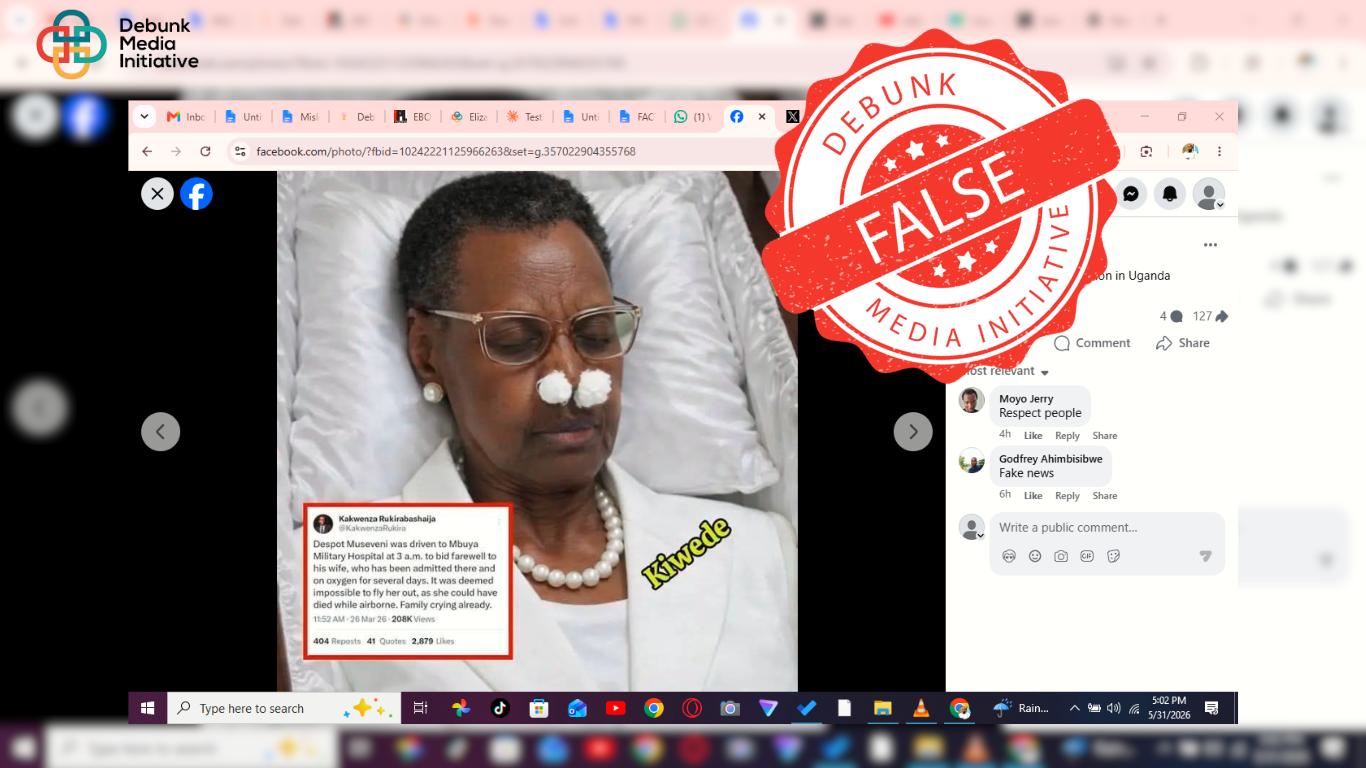
A Facebook user, Dev Kateregga, shared an image appearing to show Uganda’s First Lady and Minister of Education and Sports, Janet Kataaha Museveni, lying in a coffin with cotton placed in her nostrils. The post was captioned, “She is Minister for Education in Uganda.”
The image also contained an embedded screenshot of an X post by user @KakwenzaRukira dated March 26, 2026, claiming that President Yoweri Museveni had been driven to Mbuya Military Hospital at 3 a.m. to bid farewell to his wife, who was allegedly receiving oxygen support and in critical condition.
The post implied that Janet Museveni had died.
Findings:
Our investigation found no credible evidence supporting the claim that Janet Museveni is dead.
To establish whether there was any basis for the allegation, we first examined the claim contained in the embedded X post. Using the Debunk Info Verifier, we queried the phrase “Janet Museveni admitted to Mbuya hospital.”
The verifier returned information indicating that rumours had circulated regarding Janet Museveni’s health, including claims that she had been admitted to Mbuya Military Hospital. However, the results also referenced reports stating that she had fallen ill but was recovering. According to information surfaced by the verifier, Brigadier General Nalweyiso stated that Janet Museveni’s condition had improved and asked the public to continue praying for her.
We also investigated the reference in Kakwenza’s post suggesting that family members were already mourning. Using the Debunk Info Verifier, we queried the phrase “Janet Museveni family mourning.”

The verifier returned information indicating that the Museveni family had recently been mourning the death of Mathew Richard Rubahama Kazoora. The results showed that President Museveni and Janet Museveni had publicly expressed condolences during tribute activities related to Kazoora’s death, but this was way back in 2025. No evidence linked the reported mourning to Janet Museveni herself.
A reverse image search further revealed that the image portraying Janet Museveni in a coffin has been widely circulated on social media platforms, particularly Facebook. However, the search produced no credible news reports confirming her death.

Additionally, searches of official government communication channels, and reports from reputable local and international media organisations yielded no announcements or reports confirming that Janet Museveni had died.
We found no evidence that the image depicts a real event involving Janet Museveni. The image circulated alongside unverified claims, and no credible source has reported or confirmed her death. The image appears to be a digitally edited composite containing a photograph and added graphic elements designed to reinforce the claim.
Assessing the Plausibility of the Claim:
Could the Death of a High-Profile Public Figure Such as Janet Museveni Realistically Remain Concealed for More Than Two Months Without Credible Evidence Emerging?
While governments and families sometimes temporarily withhold information regarding the illness or death of senior public figures, historical examples show that such secrecy is usually limited in duration and often connected to specific political, military, or security concerns.
Within the African context, one of the most notable examples is that of former Ethiopian Prime Minister Meles Zenawi. In the months leading up to his death in 2012, Ethiopian authorities provided limited information about his health while he remained absent from public view. The lack of official communication fuelled widespread speculation about his condition. However, although details of his illness were closely guarded, his death was eventually publicly announced and could not be concealed indefinitely.
Similarly, several African historical cases have involved allegations that governments concealed the circumstances surrounding the deaths of prominent individuals rather than the deaths themselves. For example, investigations into the 1980 death of Guyanese historian and political activist Walter Rodney, as well as later inquiries into the deaths of figures such as Thomas Sankara and Albert Luthuli, focused on whether authorities obscured the causes of death or the individuals responsible. In each case, the deaths themselves were publicly known, while questions persisted regarding the surrounding circumstances.
These examples suggest that while information about a public figure’s health may be restricted and details surrounding a death may be disputed or concealed, it is considerably more difficult to conceal the death of a nationally prominent figure for an extended period without credible evidence emerging.
In the case of Janet Museveni, the rumours regarding her alleged death have circulated since March 2026, largely following reports and speculation about her health and absence from public view. However, by the end of May 2026, our investigation found no official death announcement, no credible reporting from reputable local or international media organisations, no statements from family members or senior government officials confirming her death, and no independently verifiable evidence supporting the claim. Instead, the claim appears to rely primarily on social media speculation, an unverified image, and a social media post alleging illness.
If Janet Museveni had died in March 2026, it would be reasonable to expect that by the end of May 2026 some form of credible corroborating evidence would have emerged, including official communication, statements from political figures, independent witness accounts, funeral preparations, credible media reporting, or documentary evidence.
Our investigation found no such corroborating evidence. While temporary secrecy surrounding the health or death of prominent figures is historically documented, maintaining complete secrecy regarding the death of a serving First Lady and cabinet minister for more than two months without credible evidence emerging would be difficult and would require an unusually high degree of coordination across numerous institutions and individuals.
Therefore, although prolonged concealment is not historically impossible, the absence of independent supporting evidence after more than two months significantly weakens the plausibility of the claim that Janet Museveni died and that her death has remained successfully hidden.
Given Janet Museveni’s position as Uganda’s First Lady and Minister of Education and Sports, her death would be expected to generate immediate confirmation and extensive reporting from official and credible sources. No such reporting was found.
Methodology:
To investigate the claim, we analysed the Facebook post and the image attached to it, including the embedded X post cited as evidence.
We then used the Debunk Info Verifier to examine key aspects of the claim, including reports that Janet Museveni had been admitted to Mbuya Military Hospital and suggestions that her family was already mourning her death.
A reverse image search was conducted to trace the circulation of the image and determine whether it had previously appeared online or been linked to credible reports.
Finally, we reviewed official government communication channels and reports from reputable local and international media organisations to determine whether any verified evidence existed confirming Janet Museveni’s death.
Verdict:
False. There is no verified evidence that Janet Museveni is dead. The claim is supported only by an unverified image and a social media post that provides no evidence for the allegation. Available evidence indicates that the image forms part of a recurring misinformation narrative that has circulated online without credible confirmation.